Trichord Sweep Pairs Guitar Instrumentalist Sweep Arpeggios
[s3bubbleVideoSingle bucket=”media.muse-eek.com” track=”videos/TrichordSweepPairsWebsite.mp4″ aspect=”16:9″ autoplay=”false” download=”false”/]
Trichord Sweep Pairs is a comprehensive investigation into the possible sweeps created by stacking one 3 note group on top of another. This course only explores the 3 note structure pairs that contain the same interval content. Further down this page you can watch videos where these Trichord Sweep Pairs are applied to various vamps and songs. The vamps and songs are also made up of the same two trichords as the sweeps being used.
If you are a guitarist we also highly recommend that you also work with the Guitar Technique and Physiology Course so that you learn Sweep Arpeggios with the proper technique. This course gives you a comprehensive approach to playing guitar and includes a video on playing sweeps.
A Trichord is just a fancy name for any 3 note structure. “Trichord Sweep Pairs” means there are two 3 note structures stacked one on top of the other to create some of the most interesting sounding sweep patterns you will ever hear!
It is a comprehensive exploration of 2,440 pages of sweep patterns! It also includes:
The Trichord Sweep Pairs-Guitar Instrumentalist Sweep Arpeggios course is logical and easy to follow. It is divided into two kinds of PDFs. First, you have “Diagrams.” This contains a small number of choice sweep patterns. This list is then optimized for guitarists by presenting fret board diagrams and fingerings for each sweep.
The second type of PDF is the “Suggested Fingerings” which is divided into four parts. These four PDFs give you ALL possible structures for each 3 note type. In many cases there are a large number of sweep patterns. By including this list you now have a complete resource to find the right sweep for any situation.
With each of the 12 sweep types, information is presented about applying them, plus investigations on what else can be extracted from the two trichord pairs concept.
Trichord Sweep Pairs course gives you tons of unique information about how to apply the sweeps in including:
Trichord Sweep Pairs-Guitar Instrumentalist Sweep Arpeggios uses pitch class set theory and specifically “prime form” reduction to express and organize each sweep. In a nutshell, pitch class set theory and “prime form” reduces any structure to its smallest interval content in order to help you organize and see internal relationship with any group of notes.
I have included a video with this course to help you understand pitch class set theory and specifically “prime form.” The video moves along very slowly through the information so that you can grasp each concept. Much of the information used in this course was derived from my book “Sonic Resource Guide” which is a reference book for the improvising musician showing all scales and the chords that will function over these scales in all keys, among other things. I highly recommend this book because you will find pitch class theory to be a great way to help you organize and apply scales and other patterns. You can also find out more about pitch class set improvisation and other books on the subject at Bruce Arnold Artist Website.
There are 12 possible 3 note structures that are explored in the Trichord Sweep Pairs-Guitar Instrumentalist Sweep Arpeggios Course; they are derived from reducing all 3 note combinations into “prime form.” These 12 forms are listed below in “prime form.” This is only a very partial listing. A complete list for all 12 sweep types is found within the Trichord Sweep Pairs Course.
All three note structure reduce to one of these 12 possible structures. This reduction gives any student a manageable system to recognize and learn all 3 note structures.
Most students are only used to “triadic” structures when working with 3 note combinations and commonly refer to them as “triads.”
This course uses the terminology “Trichords” which includes not only triads but all possible structures that you can built with any 3 notes.
For most students I would recommend starting with the “Diagram” sweeps found in this PDF and then later move into the “Suggested Fingering” sweeps when you feel that you want to expand a particular set of trichord sweeps. Please keep in mind that both the “Diagram” and the “Suggested Fingering” sweeps have important information supplied at the beginning of each new section. I’ve also included videos when available, so you can listen to compositions composed with the a specific pitch class set. You will also find an excerpt from a sweep arpeggio study for each of the 12 trichords included in this course.
All 12 trichords in this course are useful, but some are used more specific situations and may not be a combination that you find appealing depending on your interests. As a general statement I think it is best and easiest to hear the trichord sweeps based on 027 and 037. Most students are comfortable with this type of sound so it’s a good place to start.
The video below shows you a vamp that was created using Trichord Sweeps and improvisation where 013 is used. You will notice the exact trichord sweep pair showing up on the screen as the video progresses. The course download will contain the full version of this video which is about 9 minutes in duration.
[s3bubbleVideoSingle bucket=”media.muse-eek.com” track=”videos/013_Trichord_Sweep_Pairs_For_Website.mp4″ aspect=”16:9″ autoplay=”false” download=”false”/]
Although we may associate sweeps with Heavy Metal, they are usable by any musician in any idiom and add excitement and color. Here is a recommended way to start based on style:
The video below shows you a excerpt from a composition that was created using 014 Trichord Sweeps and the improvisation montuno is made up of 014’s. The exact trichord sweep pair used will show up on the screen as the video progresses. The course download will contain the full version of this video which is about 9 minutes in duration.
[s3bubbleVideoSingle bucket=”media.muse-eek.com” track=”videos/014_Trichord_Sweep_Pairs_Website.mp4″ aspect=”16:9″ autoplay=”false” download=”false”/]
Since the number of possible trichord sweep pairs is enormous, the tendency is to think that this is an overwhelming course that will take years of study. While mastering everything presented in this course would be quite an undertaking, that isn’t a common- sense approach. Here are some suggestions:
The video below shows you a excerpt from a composition that was created using 015 Trichord Sweeps and the improvisation is only made up of 015 combinations. The exact trichord sweep pair used will show up on the screen as the video progresses. The course download will contain the full version of this video which is about 7 minutes in duration.
[s3bubbleVideoSingle bucket=”media.muse-eek.com” track=”videos/015_Trichord_Sweep_Pairs_Website.mp4″ aspect=”16:9″ autoplay=”false” download=”false”/]
Example One from 014 Trichord Sweep Pairs. This is from the “Diagrams” section of the course which can be used by any instrumentalist but is optimized for guitarists. These 014 sweeps work over a C7 chord. Sweeps are presented in ALL KEYS:
Example Two from 027 Trichord Sweep Pairs. These are some of my favorite Trichord Sweep Pairs. This is again from the “Diagrams” section of the course which can be used by any instrumentalist but is optimized for guitarists. These 027 sweeps work over a C-7 chord. Sweeps are presented in ALL KEYS:
Example Three from 016 Trichord Sweep Pairs are your go-to sweeps for Dominant 7 chords. This is from the “Suggested Fingerings” section which can be used by any instrumentalist but is optimized for guitarists. These 016 sweeps work over a F7 chord. Sweeps are presented in ALL KEYS:
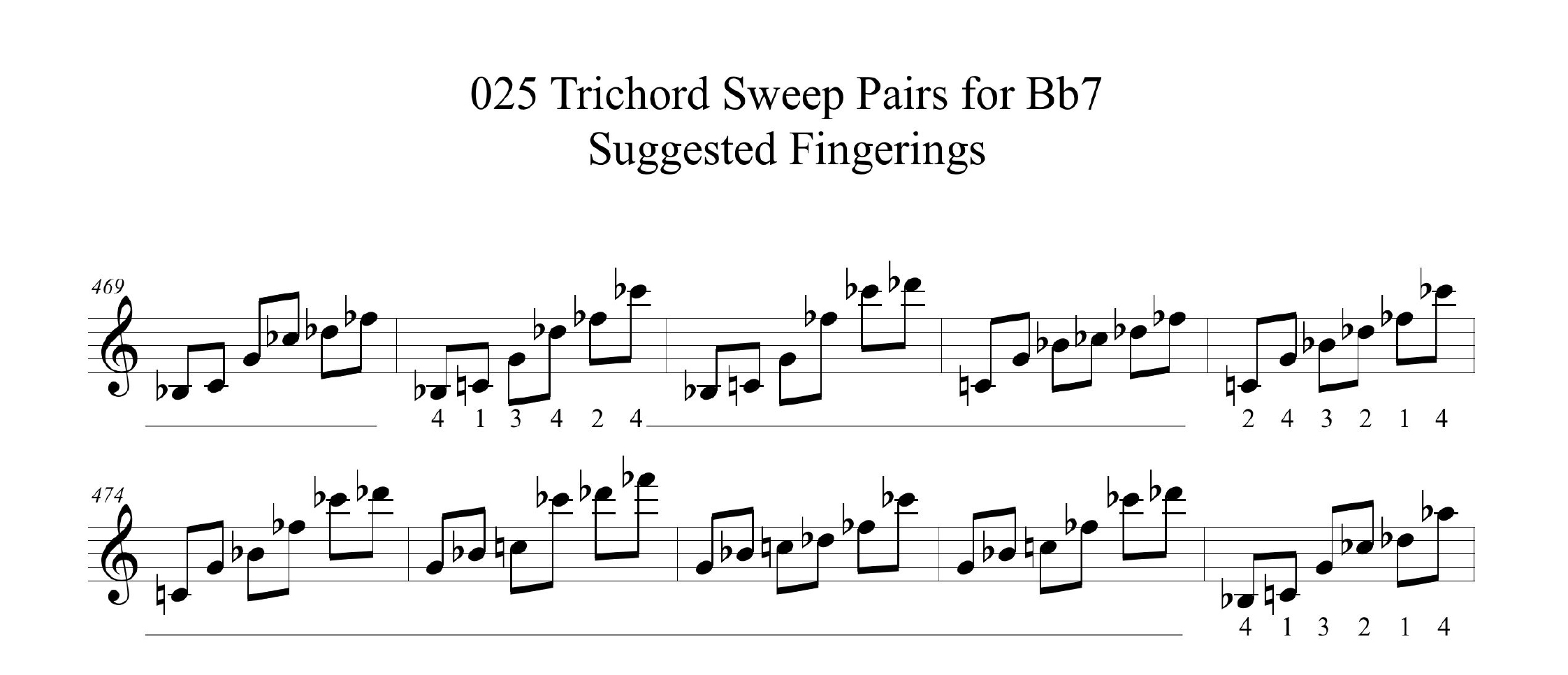
Example Four from 025 Trichord Sweep Pairs-Guitar Instrumentalist Sweep Arpeggios. 025 Trichord-Sweep-Pairs-Guitar-Instrumentalist-Sweep Arpeggios use the same intervals as the Major and Minor Pentatonic Scales. They sound great on Major, Minor and Dominant chords. Again from the “Suggested Fingerings” section, which can be used by any instrumentalist but is optimized for guitarists. These 025 sweeps work over a Bb7 chord and are some of my favorites. Sweeps are presented in ALL KEYS:
Trichord Sweep Pairs-Guitar Instrumentalist Sweep Arpeggios has been divided into two parts because of the high number of sweeps found in this course. The following organizational principles have been used:
Octatonic Chords by Bruce Arnold Diatonic Chords for 124 Eight Note Scales From the Pitch…
495 Eight Note Scales in all 12 keys by Bruce Arnold This is part of…
Segmenting Bebop Scales with Approach Notes by Bruce Arnold by Bruce Arnold 124 Eight Note…
Segmenting Bebop Scales 124 Ascending and Descending Permutations by Bruce Arnold Part of the Octatonics…
Bebop Scales 124 Bebop Scales and Their Application Add digital copy to cart - $19.99…
Octatonics and courses dealing with Octatonic Scales, Chords, Tetrads and Bebop Scales by Bruce Arnold…