

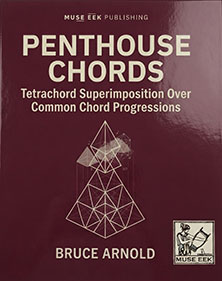
Penthouse Chords
Tetrachord Superimposition Over Common Chord Progressions
By Bruce Arnold — Muse Eek Publishing Inc. — ISBN 978-1-59489-182-3
29 tetrachords. 13 progressions. Every key.
Penthouse Chords takes superimposition beyond triads and trichords to four-note structures — the complete set of 29 tetrachord prime forms, systematically applied over every common chord type across all twelve keys. The next frontier in harmonic vocabulary.
Penthouse Chords builds directly on trichord superimposition. Comfort with several trichords over common chord progressions will make the four-note material significantly more accessible. The ear training path is the same — SerialEar trichord fluency transfers directly to tetrachord work.
What’s included with the book
The Concept
Where to Begin
S1 & S2
Example Files
Blue Eleven
Practice Path
Ear Training
Companion Volumes
FAQ
Penthouse Chords — Complete Book + Downloads
The full book in PDF, with access to all downloadable files: melodic études, études with rests, chord études, guitar chord études, chord voicings, guitar chord voicings, arpeggios, and the complete Diminished Blues set — all 29 tetrachords across all thirteen progressions and all twelve keys.
The Concept
Upper-structure triads give you three notes above the chord. Trichord superimposition (Sonic Single) extends that to any three-note structure from the chromatic scale. Penthouse Chords takes the next step: four-note structures — tetrachords — superimposed over every common chord type.
In pitch-class set theory, four-note structures reduce to 29 distinct prime forms. Each prime form is an interval shape — a specific arrangement of four pitches that sounds the same regardless of transposition. When you practice a tetrachord in all twelve keys, you internalize one shape that works across many harmonic contexts, not twelve separate things.
Why 29?
The 29 tetrachord prime forms divide into three groups based on how they relate to diatonic harmony:
- Five come from stacking thirds through the major, melodic minor, harmonic minor, and harmonic major scales — these are the Penthouse Chords themselves. Every dominant 7th, minor 7th, major 7th, minor-major 7th, and diminished 7th chord you have ever played reduces to one of these five prime forms.
- Seven come from stacking diatonic fourths through the same scales — the quartal structures that define modern jazz comping.
- Seventeen are unreachable by either method. They only appear through chromatic superimposition. These are the frontier.
This book covers all twenty-nine equally, with étude files, chord voicings, and arpeggios for every tetrachord across every chord type and key.
Where to Begin: Three Groups That Bear the Most Fruit
Not all 29 tetrachords are equally accessible as starting points. The book organizes the material into three groups, each with immediately usable results:
The Five Most Important Four-Note Structures
Of the 29 possible tetrachords, five account for every diatonic 7th chord built by stacking thirds through any common scale — major, melodic minor, harmonic minor, and harmonic major. These five are the harmonic skeleton of tonal music. Every dominant 7th, minor 7th, major 7th, and the other common chord types you already play every day reduce to one of them. They are sounds you have been absorbing your whole musical life, now made conscious and systematic. This is where the book begins — and where most players will spend the most productive early practice time.
One of the most useful discoveries the prime form system reveals: several familiar chord types share the same four-note structure. Dominant 7, half-diminished, and minor 6 are all the same tetrachord. Minor-major 7 and augmented major 7 are the same tetrachord. Any superimposition that works over one automatically works over the others — instantly doubling or tripling your harmonic coverage.
The Four-Note Structures That Build Quartal Harmony
A second, smaller group of tetrachords emerges when you stack diatonic fourths rather than thirds through the same scales. These are the structures behind the open, modern sound of McCoy Tyner, Bill Evans’s left hand, and post-bop jazz comping generally. The book covers all of them, including those that require the diminished fourth — an interval that sounds like a major third but is spelled as a fourth, and that gives certain quartal voicings their distinctive edge over altered dominants and harmonic minor contexts.
The Diminished Scale Tetrachord
Before moving into the 17 non-diatonic tetrachords, the book devotes a full chapter and a dedicated étude set to the single tetrachord produced by the diminished scale. Used across its three transpositions, this one structure covers an entire 12-bar blues progression with three different octatonic scales. The Diminished Blues étude is self-contained, immediately musical, and one of the most practical tools in the book.
Structure 1 and Structure 2
Almost every tetrachord appears in the étude files in two versions: S1 and S2. This is because 28 of the 29 prime forms are asymmetric — reading the interval sequence in reverse produces a different set of notes, a different sound, and different harmonic applications.
The best example is Major 7 (0158). S1 is C, Db, F, Ab — tight, chromatic, works over DbΔ7 and Eb-7. S2 is C, E, G, B — the familiar close-position C major 7th voicing. Same prime form. Completely different sounds, working over completely different chord roots.
Getting the structure wrong means the notes clash with the harmony. Getting it right means the superimposition is seamless. The S1/S2 distinction is not a technicality — it is the difference between a tetrachord that fits and one that doesn’t.
The one exception is Diminished 7 (0369): three equal minor thirds produce a palindrome, so S1 = S2. This is also why the diminished 7th chord has only three distinct transpositions in the entire twelve-tone system.
The S1/S2 inversion operation is the same mathematical operation that underlies negative harmony. If you already work with axis reflection and chord mirroring, the S2 of each tetrachord gives you a practiced, systematic vocabulary for the mirror side.
Example Files
Each example below shows one page from a representative étude file, with the first few bars audible as MP3. The complete library — all 29 tetrachords across all 13 progressions and all 12 keys — is included with the book.
All four inversions ascending then descending through all twelve keys, in 6/8 time. The arpeggio files build physical command of each tetrachord before applying it to chord progressions. Structure S1 and S2 are in separate files for all asymmetric tetrachords.
The Minor-Major 7 tetrachord (0148) over a descending chromatic dominant progression. Random rests break up the constant eighth-note stream, creating a more conversational phrase shape — and revealing whether the material has been truly internalized or just memorized mechanically.
Drop-2 voicings on the upper four strings over a chromatic descending dominant progression — one of the most common cadential sequences in jazz. All twelve keys. The drop-2 format places all four notes within a four-fret position.
Three bars per key: ascending inversions as quarter notes, peak voicing plus descending, root position whole note. One of the five Penthouse Chords and one of the most common voicings in jazz — here made systematic across all positions and keys.
Three transpositions of the diminished tetrachord as drop-2 chord voicings over a 12-bar blues, three choruses. Moving between C7, F7, and G7 requires only a half-step shift — a direct consequence of the diminished tetrachord’s unique symmetry. The most immediately usable étude in the book.
Blue Eleven — The 23rd Chord in Practice
Blue Eleven is a composition by Bruce Arnold in the key of G, eleven measures long — a traditional blues with one bar removed. The guitar melody is built entirely from the 23rd chord concept developed by jazz educator Charlie Banacos: three seventh-chord arpeggios stacked in ascending thirds, covering all twelve chromatic pitches.
Each of those three arpeggios is a tetrachord. Together they form a twelve-tone aggregate — three tetrachords that partition all twelve pitch classes with no overlaps. This is the principle at the heart of Chapter 11 of the book, shown here in a real compositional context.
Follow the score and notice how the three seventh-chord arpeggios rotate through their positions as the harmony moves through G7 → C7 → G7 → Bb7 → A7 → Ab7. The complete twelve-note aggregate sits naturally inside a straight-ahead jazz blues.
Recommended Practice Sequence
The book recommends this order — starting with sounds your ear already knows, then moving to increasingly unfamiliar territory:
- This course teaches you the five most important Penthouse Chords first — the five tetrachords that account for all diatonic 7th chords. Your ear already knows these sounds. The work is making the superimposition conscious and systematic, in all twelve keys.
- Next, The seven quartal tetrachords — These are the open more modern sound of McCoy Tyner and post-bop harmony. Some require the diminished fourth — an interval that sounds like a major third but is spelled as a fourth. The book covers this distinction in detail.
- The diminished tetrachord in all three transpositions — the Diminished Blues étude before moving to the other seventeen tetrachords. This establishes the octatonic system as a practical, playable tool.
- The remaining seventeen tetrachords — the frontier. These only appear through chromatic superimposition; no diatonic stacking method ever produces them. SerialEar ear training is the recommended companion for this stage.
Ear Training Path
| Level | Resource | What It Builds |
|---|---|---|
| 1 | Ear Training One Note Complete | Identify any of the twelve chromatic pitches against a key center — by ear, not by counting intervals. |
| 2 | Contextual Ear Training | Hear pitches in context of moving chord progressions — how function changes what a note sounds like. |
| 3 — Critical | SerialEar | Hear all twelve trichords in every inversion and transposition. Every tetrachord contains four overlapping trichords — SerialEar fluency makes the tetrachord étude material audible rather than mechanical. |
Not sure where to start? The free Ear Training Guided Tour maps the full curriculum.
Recommended Companion Volumes
| Book | How It Relates |
|---|---|
| Sonic Single | The natural predecessor. Where Penthouse Chords works with four-note structures, Sonic Single covers all twelve trichord prime forms. Complete or familiar with Sonic Single before starting this book. |
| SerialEar | The critical ear training companion. Trichord fluency from SerialEar transfers directly to tetrachord work — every tetrachord contains four overlapping trichords. |
| Chord Workbook Volume 2 (CW2) | The source of the 775 guitar voicing analysis referenced throughout this book. Drop-2 voicings on the upper four strings across all chord types and keys — the harmonic foundation the Penthouse Chords system is built on. |
| My Music | The theoretical and compositional foundation. Documents the pitch class set system and harmonic rhythm principle that underlies the Penthouse Chords approach. |
| MetroDrone® | Combined drone and metronome. Every étude file in this book is designed to be practiced against a drone in a single key center — MetroDrone is the tool for that. |