Modal Sequencing -Two Note for All Instrumentalists
Two Note Modal Sequencing
Two Note Modal Sequencing for All Instrumentalists
The Two and Three Note Modal Sequencing are available as a BUNDLE. Please see this information before purchasing the Three Note Modal Sequencing course separately.
Modal Sequencing has long been a tool that musicians use to create great melodies and to improve their technical ability and aural comprehension. This series of courses which is available as a cost effective BUNDLE covers Two and Three Note Modal Sequencing and provides a student with a comprehensive range of information on multiple levels to help understand this crucial aspect of music. Twenty Nine different modes are covered for a student to practice and master these important structures. Each course from Modal Sequencing shows how every melodic sequence could be changed to create not only other melodic but also rhythmic permutations, which gives an improviser many choices when applying these melodies. A PDF showing the modal sequence along with MP3s and Midi files to hear each exercise have been included for all sequences. This greatly aids overall development because the student can check their accuracy when playing, singing or doing ear training exercises. Each course of the Modal Sequencing provides you with multiple exercises that you can do to improve your ear training skills. No matter how you use these exercises, by working with them you are using musically familiar patterns that will prepare you to improvise or compose over common melodies you encounter throughout your musical life.
There are many ways these modal sequences can help your musicianship. Below are just some of the uses you will find for these courses:
Developing new ideas for improvising whether you are a beginner or an advanced player
Developing a deeper knowledge of the scales included in this study.
Developing your technical skills. Modal Sequences are a “super” chops building machine.
Developing your ear training skills by singing and hearing various examples.
Developing the ability to both technically and aurally recognize common melodic movement.
Developing a melodic language that allows you to be more compositional in your improvisations
Developing a way to organize scalar ideas.
Developing a way to use these melodic patterns on multiple metric levels.
Please Note: If you are a guitarist we highly recommend that you also work with the Guitar Technique and Physiology Course so that you develop the modal sequences with the proper technique.
What’s in This Course?
First, if you look further down on this page you will see examples from PDFs from the series so you can get a better idea of the layout of each course. Modal sequencing is playing through a scale with a pattern, such as playing a scale ascending and descending with thirds. This type of technique has been around since at least the 17th century. One listen to Johann Sebastian Bach’s music will give you many examples of using modal sequencing as will listening to any Jazz, Blues or Heavy Metal player.
Videos are included to help you apply modal sequencing and play them more musically.
Here is a list of videos include:
Click on triangle to see lists of videos:
Why You Should Work With 2 Note Sequences
Working with Two Note Modal Sequences
Working with Sixths Two Note Modal Sequences
Moving in Major Thirds Two Note Modal Sequences
Moving in Fourths Two Note Modal Sequences
Applying 2 Note Sequences to Ear Training.mp4
Two Note Modal Sequencing
Two Note Modal Sequencing includes a massive amount of PDFs, MP3s and Midi files so that you can customize your study.
Two Note Modal Sequencing
Two Note Modal Sequencing Course
The Two Note Modal Sequencing Course contains all 29 scales in the Two Note Series. It will allow a student to learn the most commonly used scales on their instrument plus it contains multiple ear training exercises to internalize the common melodies that are used in all types of music. If you want MEGA CHOPS then look no further. These modal sequences will give you a massive quantity of awesome melodies and if you use the midi files you can speed up your technique over time. These modal sequences are also great for exploring new improvisational ideas, so if you are tired of playing the same old thing, then this is the ticket to expanding your melodic palette!
Two Note Sequences Contain All Melodic Intervals Within an Octave
Remember that the two note modal sequences contain all melodic intervals so learning these sequences prepares you for any melody. In addition, the 29 scales provide you a lexicon of multiple melodic intervals within each sequence so you are covering a large number of the melodic shapes you may find in music.
Who should use the Modal Sequencing course?
The quick answer is EVERYONE! But seriously, these sequences help you develop new ideas for improvisation and they will show up in your playing fast. They built build mega-chops but they also make your improvisation more compositional because you can pick sequences that have more affinity with a particular song rather than playing the same type of melodies on all songs. Modal Sequences also help you learn your instrument better and help you recognize scale patterns quickly. Modal sequences sound good at a slow or fast tempo so you will get great use out of them in your improvisations.
Playing Modal Sequences at Different Metric Levels
Playing modal sequences at multiple metric levels not only makes every sequence you learn more useful, but by also changing the type of rhythm used you can further disguise the sequence. Our Two Note Modal Sequence course goes into great detail on these subjects.
Examples from the Two Note Modal Sequencing Course.
Below are some examples from the Two Note Modal Sequencing Course which contains all 29 modes. There are five different types of files and each is tailored for a specific student level. You will find even more examples if you scroll down into the individual course offerings.
Click on triangle to see a PDF example for first type of files.
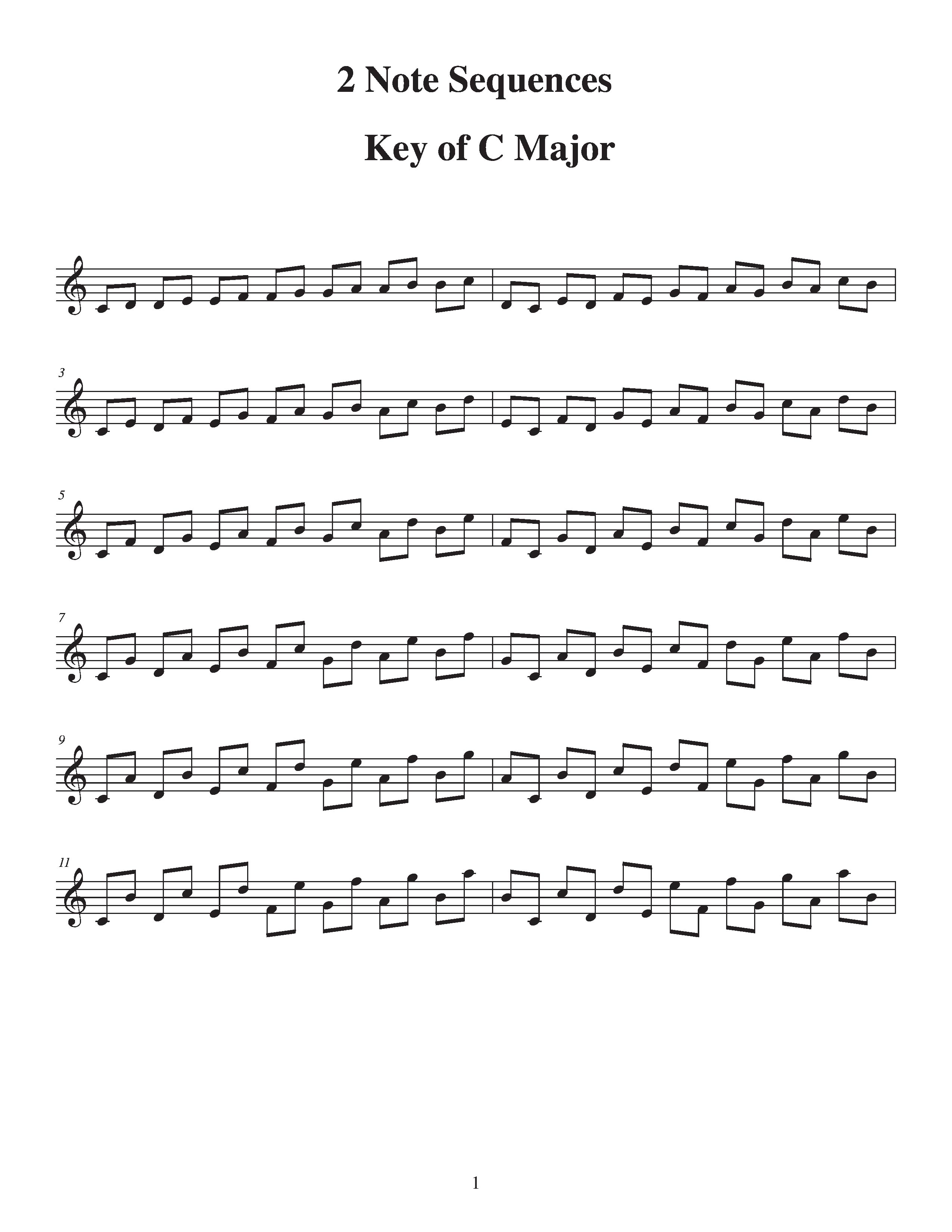
The page below shows multiple one octave ascending and descending sequences for C Major. Each line contains a new sequence. This is a good place for an advanced student to start because the only the ascending part of the scale is shown and it is assumed that the descending part will be easy to calculate. All modal sequences are written out for every mode and every key.
There is no audio for these files
These type of files are meant for an advanced student who only needs to work with the ascending version of a sequence and can deduce the rest of the notes.
There are no audio files with these sequences.
Each sequence is presented in all 12 keys.
Click on triangle to see a PDF example for second type of files.
The page below shows multiple one octave ascending and descending sequences for a Eb Lydian b7 Scale. Each line contains a new sequence. This is a good place for an intermediate or advanced student that only needs to see the sequence written ascending. All modal sequences are written out for every mode and every key.
There is no audio for these files
These files present all the 2 Note Modal Sequences in one file which moves through all 12 keys.
There is no audio for these types of files.
Each sequence is played Ascending and Descending through one octave.
There are twelve two note sequences for each key. All 12 keys are included.
Click on triangle to see a PDF example for third type of files.
This Minor Pentatonic modal sequence is shown in triplets. This is one of many possible ways to change the rhythm of a modal sequence which can make it much more musical. This example shows a new modal sequence every two bars. The sequence moves two octaves ascending and descending. Again the presentation of the entire sequence is helpful when a student needs to see the entire sequence to play it correctly.
There is no audio for these types of files.
Playing two or four note modal sequences in triplets or other odd rhythm groupings is a great way to disguise a sequence and also give it more interest.
Because these modal sequences are played ascending and descending through two octaves they are good files for an intermediate level student to use to learn a sequence.
Click on triangle to see a PDF example for fourth type of files.
This example shows both permutations of a 2 note modal sequence in C Lydian#2#5 scale using 6ths and ascending and descending one octave.
There are 504 MP3s for this type of file. An example MP3 for the above score is found below:
There are also 504 midi files for these PDFs so you can play them at any tempo.
You can use these études for ear training, sight reading, transcription or just to listen to ingrain the sound of the note in the key center. Remember, you can play these examples at any tempo, super slow or extremely fast, with the midi files that accompany this course.
Click on triangle to see the last type of exercise which shows you just one sequence.
This example shows both permutations of a 2 note modal sequence in B Phrygian b4 scale using 3rds ascending and descending one octave.
There are 1008 MP3s for this type of file. Keep in mind that there are also midi files for each example so you can play any exercise at any tempo.
You can use these études for ear training, sight reading, transcription or just to listen to ingrain the sound of the note in the key center. Remember, you can play these examples at any tempo… super slow or extremely fast with the midi files that accompany this course.
Get the Two Note Modal Sequencing Bundle
ISBN: 978-1-59489-427-5 This course includes: 54 Page PDF, 6 Videos 15 minutes in total, 6,048 MP3s and 6,048 Midi files
Status: Currently Available, Digital book is available for immediate download!
What people are saying:
I contacted Bruce because I was trying to get my improvisation going with the modes of major. He recommended doing some modal sequencing to give me ideas because honestly I had very few. I’m not much of a reader but by playing through a few of these sequences I quickly got some new ideas. I also purchased his “One Minute Lessons” which really helped me with adding in articulation to these various melodies. W. Volheim
I’m a sax player and really have to thank you for these modal sequences. Especially the Harmonic Major ones. It’s really hard to find any good information on them on the internet and your information on how to apply them to diminished chords really showed me that these are important scales. I also like the various types of files found in the course. I needed everything spelled out for me when I started but now I just look at the ascending part of the scale and can figure out the rest. I highly recommend this course it’s one of a kind!J. Anders
Being a singer it’s always hard to find good courses that help me learn improvisation. This course with its MP3 was exactly what I needed. Having audio files really helped me hear these melodies and Mr. Arnold was correct I started just naturally singing these melodies quickly in my improvisations. I would recommend this course wholeheartedly. G. Butterfield
I’m not one for books that much but I do like this course. I can just spend a few minutes looking at a sequence then I’ve got it and can start sticking it into my improv. I also found the information in the book useful. It was direct and to the point. S. Takeshi
Have a story or a review you want to submit. We would love to hear from you please send us an email.
Muse Eek
Muse-Eek Publishing Company is a publishing house with a broad focus on music education. Muse-Eek also publishes fine art and poetry books, and has its own record label, Muse-Eek Records. Our online presence, Muse-Eek.com specializes in the publication of music workbooks, video courses and sound and video recordings that teach the foundation of good musicianship through groundbreaking and innovative methods along with traditional methods that have been taught for centuries. These historic methods date back through centuries of great musicians and educators. To see these interesting relationship please see Bruce Arnold's Music Education Genealogy Chart which tells you a lot about the where many of his educational ideas took root and some of the educational pillars that are evident throughout the books you find on this website. The Muse-Eek Records catalogue contains a diverse selection of music much of it by Bruce Arnold in collaboration with some of today's best players in classical, jazz, rock and avant-garde music. These are available in CD, DVD and mp3 formats. We believe in a working relationship with our music education customers; they are free to interact with the author after purchasing a book to help them through any material they don’t understand or which they need further clarification. We also have a member's area which contains a wealth of free information to help a student understand music at a deeper level and access additional files for our books. Many of our books offer cutting edge ideas regarding ear training, guitar technique, rhythm and time. These methods have a proven track record. Our main author Bruce Arnold has taught at some of the most prestigious music schools in the world, including Princeton, Dartmouth, Berklee College of Music, New England Conservatory, The New School and NYU. Along with Mr. Arnold's publications on the Muse-eek.com website he has also written books and appeared in educational DVDs for MelBay and Truefire. Over the years Mr Arnold has used his experiences with his students to develop a program that can elevate a musician's ability to world class caliber. If you have questions about any of our books or recordings please send us an email. Along with general questions about either our record label or our publishing company we also welcome questions to help a student choose the proper materials to reach their goals. We have over 300 products to help you learn any style of music and to develop your musicianship to its peak. We also make recommendations for practice schedules for students who use our methods to get the most out of their study time. This, along with personal interaction with Bruce through email, nurtures the student's ability through a closely monitored situation, ensuring there is no wasted time or misunderstanding.