

The Trichord Pairs Series
| Book | Scales Covered | Combinations | Price |
|---|---|---|---|
| Trichord Pairs | Major (all 7 modes), Melodic Minor Ascending (all 7 modes) | 70 total (28 + 42) | $24.95 |
| Trichord Pairs 2 | Harmonic Minor, Harmonic Major, Whole-Half Diminished, Half-Whole Diminished, Whole Tone |
47 total (2 + 7 + 16 + 16 + 6) | $24.95 |
| Trichord Sequencing | Major (all 7 modes), Melodic Minor (all 7 modes) | 70 total (28 + 42) | $24.95 |
Get All Three — The Complete Trichord Pairs Bundle
All three books, 187 combinations across every scale family in the series —
Major, Melodic Minor, Harmonic Minor, Harmonic Major, and the three symmetric scales
— plus seven different practice-file formats across the series, from the Overview
and Sequence formats every book shares, to the Sweeps and Pair Sweeps unique to
Trichord Pairs 2, to the Six-Sweep and Cascade Sweep sequencing formats unique to
Trichord Sequencing.
Trichord Pairs (also known as Triad Pairs)
Status: In stock. Digital book, PDF, and MIDI practice files available
for immediate download.
Trichord Pairs — A Scientific Approach to
Melodic and Harmonic Mastery
This course covers a specific group of trichord pairs (also known as triad pairs) that
get used often when improvising. They are very useful as chords and melodic
replacements for the modes of major and melodic minor ascending. This course lists all
the possible 027-016 and 027-026 trichord pair combinations. What that means is you
have easy-to-play structures that will sound super modern but are also very harmonious
in any musical situation. These aren’t abstract strange sounds — they are core
structures used when playing a jazz standard or even rock, metal, and blues.
You also don’t need knowledge of pitch class sets or other special music theory
constructs. You just have a very useful sound laid out for you either as a scale, two triad
pairs, or awesome sequences that give you head-turning attention when you play them!
But if you do want to dig deeper there is an Appendix that covers in-depth the music
theory concepts found in this book. That material is from the Sonic Resource
Guide, a go-to reference used often.
Why a whole step and fifth (027) matched against either a half step and a tritone
(016) or a whole step and tritone (026)? The 027 is often used as a fourth voicing, and
melodies moving in fourths or dominant chords are often voiced with an 016 or 026 in
the upper three notes. So these combinations play sounds that aren’t going to upset
more conservative musicians, but moving between them creates a pretty unique sound
that tends to land well with most listeners. These combinations are also not difficult to
play, voice-lead well, and are easier to get into your playing fast — as opposed to
012, 013, 014, and similar sets, which are awesome sounds but take a while to get used
to.
For as long as musicians have had scales, most reach for the same handful of them
over every mode of major and melodic minor — and the same handful of chords
underneath. Trichord Pairs identifies something more specific: the exact
combinations of a 027 trichord matched against a 026 or 016 trichord that sound
genuinely striking as replacements for that default vocabulary, worked out
independently for every mode of both scales, in every key.
Naming the harmony is the easy part. This book pairs that system
with the mental practice method, physical technique, and rhythmic tool you need to
actually get it into your ear and your hands — without the repetitive-strain grind
that ends so many promising technical projects.
What This System Gives You:
- Every Valid Combination, Both Scales: All 28 valid 027-016
combinations across the seven modes of major, and all 42 valid 027-026 combinations
across the seven modes of melodic minor ascending — each independently
verified, not just relabeled from mode to mode. - A Synopsis of the Mental Practice Method:
Build a stable virtual instrument, fire the same motor pathways as live performance
below the threshold of movement, and use the ten minutes before sleep to hardwire a
combination into permanent memory. - Long Line Rhythm™ Applied Directly: The macro-pulse, anchor-point method that keeps an eighteen-bar sequence or
a two-octave scale run from turning into a note-by-note grind. Read about the MetroDrone and Long Line Rhythm for more
information. - Technique That Won’t Cost You Your Hands: The Home
Base principle, forearm-driven mechanics, and the specific hand position that lets you
practice this material for years without injury. See the Guitar Physiology
and Technique Course for the full treatment with video. - Full PDF and MIDI Practice Files: Every combination,
voiced eighteen ways, run through all twelve keys — plus a two-octave
ascending-and-descending scale run for every combination, ready to read and to
hear.
Table of Contents for Trichord Pairs:
- Front Matter: Acknowledgments, About the Author,
Foreword, Preface: How to Use This Book. - Chapter 1: Introduction — What Are Trichord Pairs?
- Chapter 2: Mental Practice
- The Virtual Instrument: Building the Internal Map.
- Sub-Threshold Motor Firing and the Both-Hands Rule.
- Cognitive Endurance: Managing Mental Fatigue.
- Aural Proofing: The Key Center Prerequisite.
- The Pre-Sleep Routine and Neurological Consolidation.
- Chapter 3: Technique and Physiology
- Home Base — The Core Principle.
- Let the Big Muscles Do the Heavy Lifting.
- The Middle Radius Constraint.
- Left Hand Basics; Right Hand and Picking.
- No Pain Is Gain.
- Chapter 4: Long Line Rhythm
- Locating the Anchor Points.
- Building Tiers.
- Applying This to the Trichord Pair Material.
- Chapter 5: The Trichord Pairs System
- Understanding the Trichords; How These Combinations Were
Found. - Melodic Minor — 027-026 Combinations (All 7 Modes).
- Major — 027-016 Combinations (All 7 Modes).
- Understanding the Trichords; How These Combinations Were
- Chapter 6: Practice Materials and Application
- What’s Included with This Book.
- How to Practice; Practicing as Chords.
- Frequently Asked Questions.
- Chapter 7: Troubleshooting, Context, and Consistency
- Conclusion
- Appendix A: The Muse Eek Ear Training Curriculum
- Appendix B: Pitch Class Sets, Chord Tones, and Available
Tensions
Examples of Exercises Found in Trichord Pairs
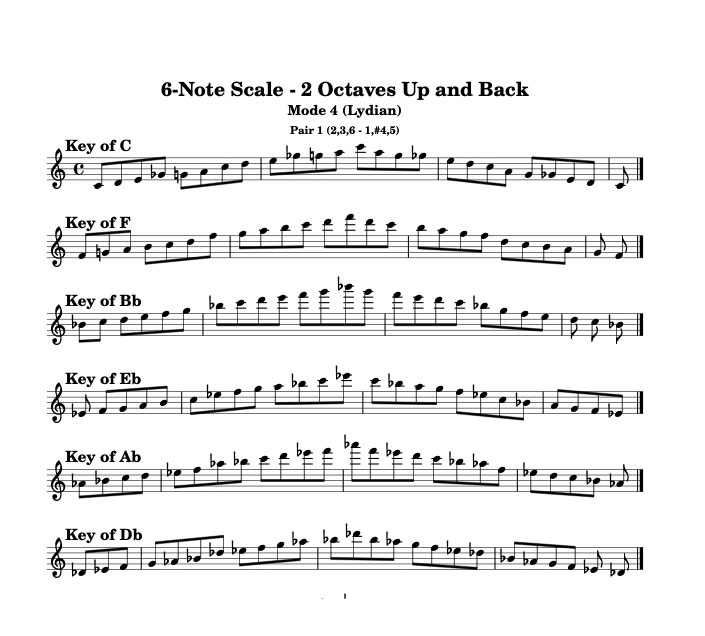
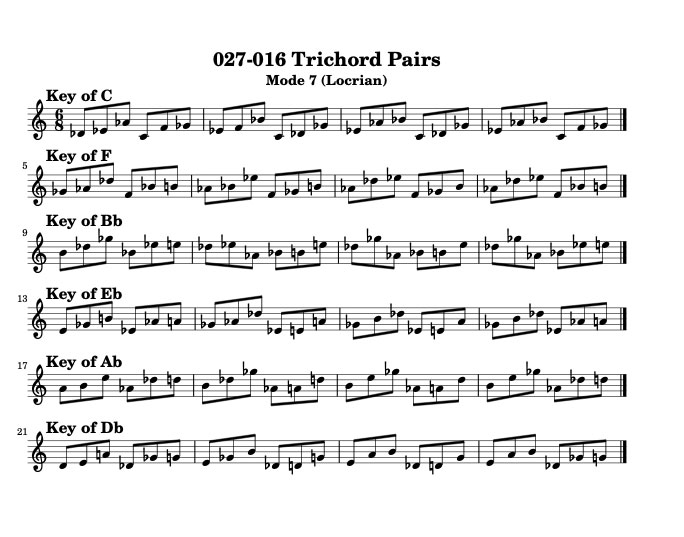
There are three types of files found in this course: hexatonic scales played
ascending and descending through 2 octaves, a simple listing of the trichord pairs in
every key center for quick lookup, and 18 permutations of each trichord pair through all
12 keys — with MIDI files for all of these exercises so you can check your
accuracy.
This first example shows a Lydian scale (minus the 7th) played two octaves
ascending and descending. Guitarists should play these scales in all 6 positions.
- Slow Tempo:
- Faster Tempo:
The example below shows the 4 trichord pairs using 027-016 that can be used for a
Locrian scale.
- Trumpet Example:
- Rock Guitar Example:

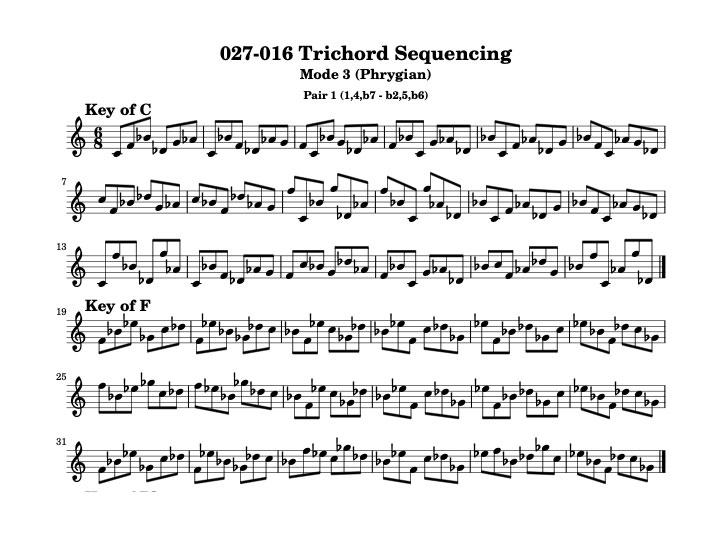
The example below shows a trichord sequencing pattern using a Phrygian scale. 18
different patterns are presented for every trichord pair combination!
- Piano Example:
- Rock Guitar Example:

ISBN: 978-1-59489-297-4
Trichord Pairs 2 (Harmonic Minor, Harmonic Major & the Symmetric Scales)
Status: In stock. Digital book, PDF, and MIDI practice files available
for immediate download.
Trichord Pairs 2 — Harmonic Minor,
Harmonic Major, and the Symmetric Scales
Trichord Pairs covered major and melodic minor ascending —
the two scales where the 027-016 and 027-026 pairing system produces the richest set
of combinations, four to six per mode. Trichord Pairs 2 takes the same
method into different territory: harmonic minor, harmonic major, and the three symmetric
scales, where the underlying interval structure changes the math entirely.
Harmonic minor and harmonic major both contain an augmented second —
and that interval narrows the valid 027-026 pairing down to exactly one combination per
mode, rather than several. This book includes both of harmonic minor’s most commonly
used modes (the tonic harmonic minor sound, and the fifth mode’s Phrygian Dominant
— the classic altered-V7 sound), and all seven modes of harmonic major.
The symmetric scales — Whole-Half Diminished, Half-Whole Diminished,
and Whole Tone — work differently again. These scales repeat their own interval
pattern around the octave, so there’s no single 027 trichord anchoring every
combination the way there is in major or melodic minor. Instead, every combination in
this section pairs two 026 trichords against each other, and because the diminished
scales are eight notes rather than seven or six, there’s substantially more valid
combinations to work through — sixteen each for the two diminished scales, six
for whole tone, where every note of the scale is used with nothing left over.
Beyond the reference charts, this edition adds two new practice formats built for
taking a single trichord to the instrument. Sweeps takes each individual
trichord in the book through its three inversions, each swept up two octaves and back
down in a register built specifically to be playable on guitar. Pair Sweeps
links a combination’s two trichords into one continuous gesture — one trichord
sweeping up, the other sweeping back down — cycling through all three
inversions of both.
The complete mental practice, technique, and Long Line Rhythm system from
Trichord Pairs carries over unchanged — this book assumes you’re
either working through it alongside the original or have been through that material once
already.
What This System Gives You:
- Harmonic Minor, Fully Covered: The tonic Harmonic Minor
sound and the Phrygian Dominant (mode 5) — the two modes of harmonic minor
musicians reach for most.
- Harmonic Major, All 7 Modes: One verified 027-026
combination per mode — the single valid pairing this scale’s own interval
structure allows.
- All Three Symmetric Scales: 16 combinations from WholeHalf Diminished, 16 from Half-Whole Diminished, and 6 from Whole Tone — 38
combinations total from scales most trichord-pair material never touches.
- Sweeps and Pair Sweeps: Every individual trichord in the
book taken through its three inversions in a guitar-practical register, plus every
combination linked into a continuous ascending-and-descending Pair Sweep.
- The Same Complete Practice System: Mental practice,
Home Base technique, and Long Line Rhythm, applied directly to this new material.
- Full PDF and MIDI Practice Files: Five kinds of files
— Overview, Sequence, Scale-Run, Sweep, and Pair Sweep — every
combination voiced eighteen ways and run through all twelve keys.
Table of Contents for Trichord Pairs 2:
- Front Matter: Acknowledgments, About the Author,
Foreword, Preface: How to Use This Book.
- Chapter 1: Introduction — What’s In This Volume.
- Chapter 2: Mental Practice (full method, as in
Trichord Pairs)
- Chapter 3: Technique and Physiology (full method,
as in Trichord Pairs)
- Chapter 4: Long Line Rhythm (full method, as in
Trichord Pairs)
- Chapter 5: The Trichord Pairs System
- Harmonic Minor — 027-026 Combinations (2 Modes).
- Harmonic Major — 027-026 Combinations (All 7 Modes).
- The Symmetric Scales — 026-026 Combinations.
- Whole-Half Diminished — 16 Combinations.
- Half-Whole Diminished — 16 Combinations.
- Whole Tone — 6 Combinations.
- Chapter 6: Sweeps — Individual trichords, three
inversions, two-octave sweeps in a guitar-practical register.
- Chapter 7: Pair Sweeps — Linking a combination’s
two trichords into one continuous ascending-and-descending gesture.
- Chapter 8: Practice Materials and Application
- Chapter 9: Troubleshooting, Context, and Consistency
- Conclusion
- Appendix A: The Muse Eek Ear Training Curriculum
- Appendix B: Pitch Class Sets, Chord Tones, and Available
Tensions — including a Trichord Usability Reference showing every chord
each trichord shape can be played over.
- Harmonic and Melodic Equivalence Volume 11B is Included in this book a 19.99 value that gives indepth information on a Harmonic Major Scale Trichord
Examples of Exercises Found in Trichord Pairs 2
There are four types of exercise found in Trichord Pairs 2 Course. There are PDFs and MIDI files for all exercises. Below is a list of the exercise types:
1. Overview Exercises show you the all possible trichords for a given scale type.
2. Scale Run Exercises in all Harmonic Major, 2 modes of Harmonic Minor and 3 Symmetrical Scales.
3. Sweep Exercise in all Modes of Major, Melodic Minor Ascending, Harmonic Major, 2 modes of Harmonic Minor and 3 Symmetrical Scales Ascendig and Descending
4. Sweep Pairs Exercise shows you two trichords played ascending and descending.
This first example shows Overview Exercise for a Mixolydian b2b6 (5th Mode of Harmonic Minor) in All Keys
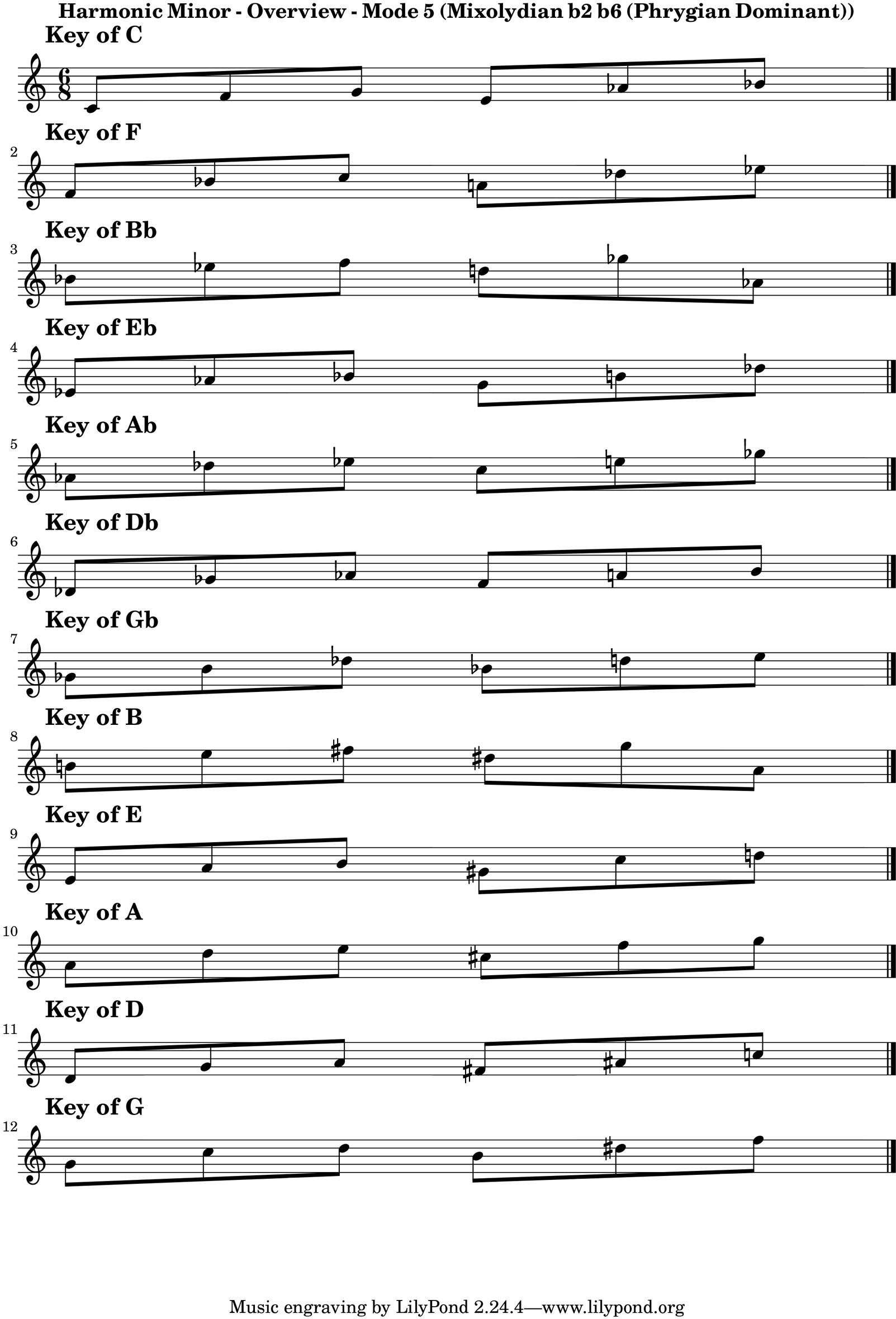
Overview Mixolydian b2b6 in All Keys:
This is the 2nd example shows Overview Exercise for a Symmetrical Diminished Scale (half step/whole step scale) in Key of C only.
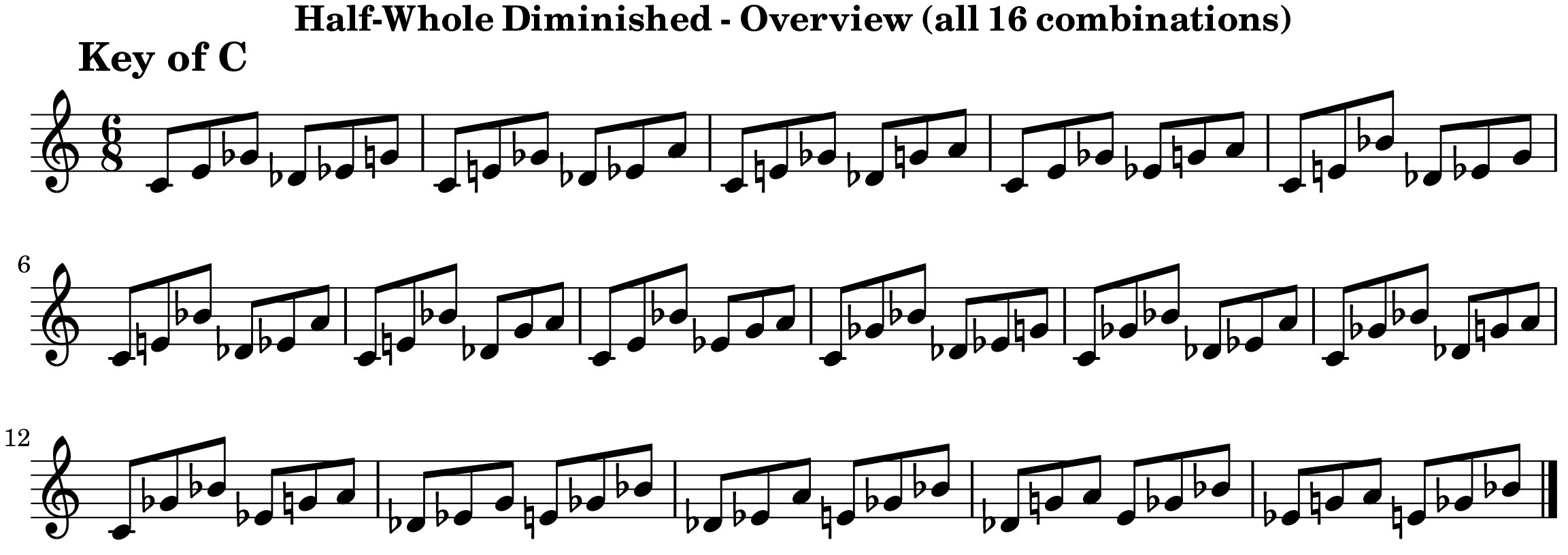
Overview Example Symmetrical Diminished:
This example shows Scale Run Exercise using a Harmonic Major Scale in the Key of C only.

Scale Run Harmonic Major Scale:
This example shows Sweep Exercise using a Major Scale in All Keys
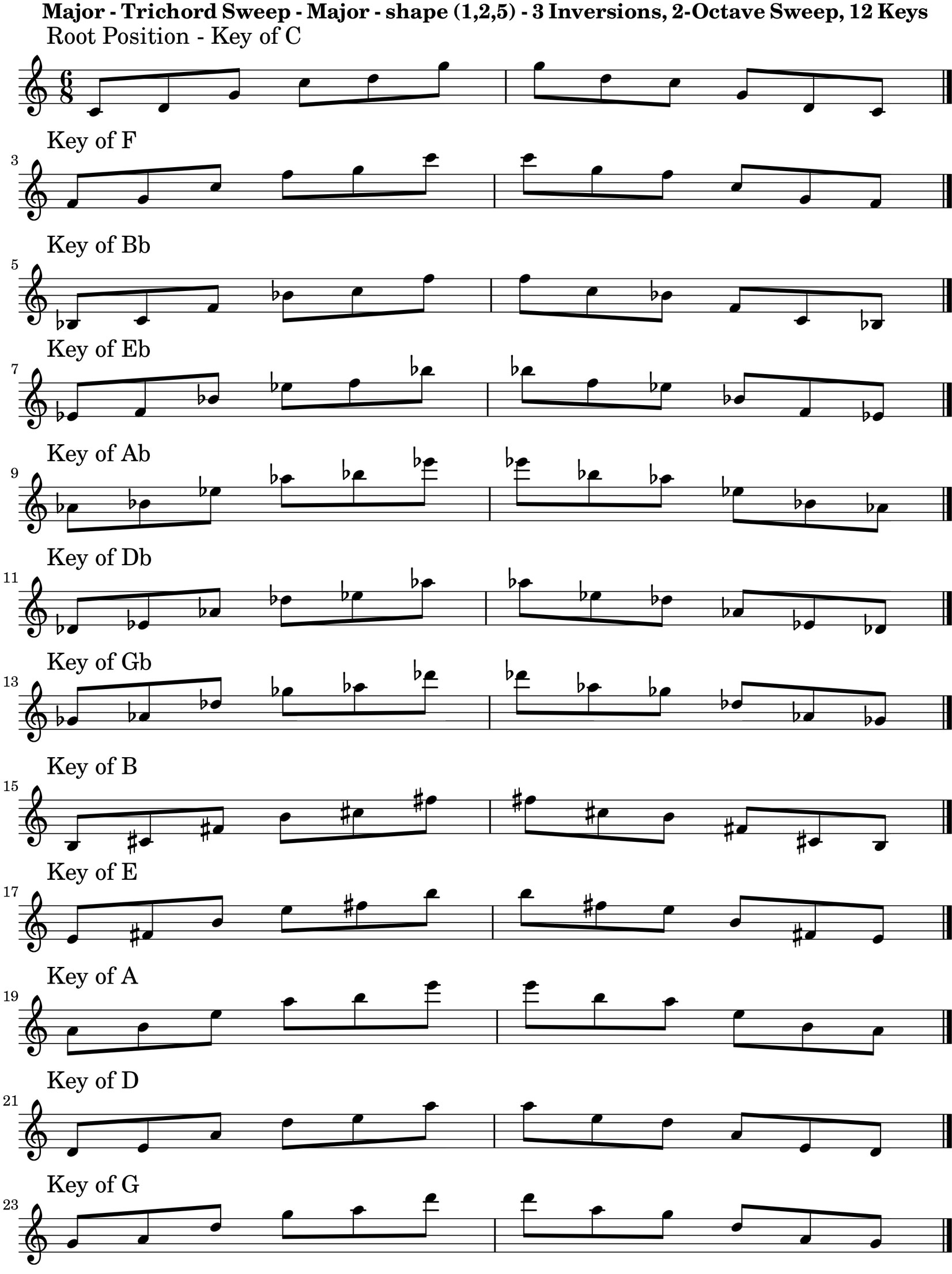
Sweep Pattern Major Scale All Keys:
This example shows Sweep Pairs Exercise using a Melodic Minor Scale in All Keys
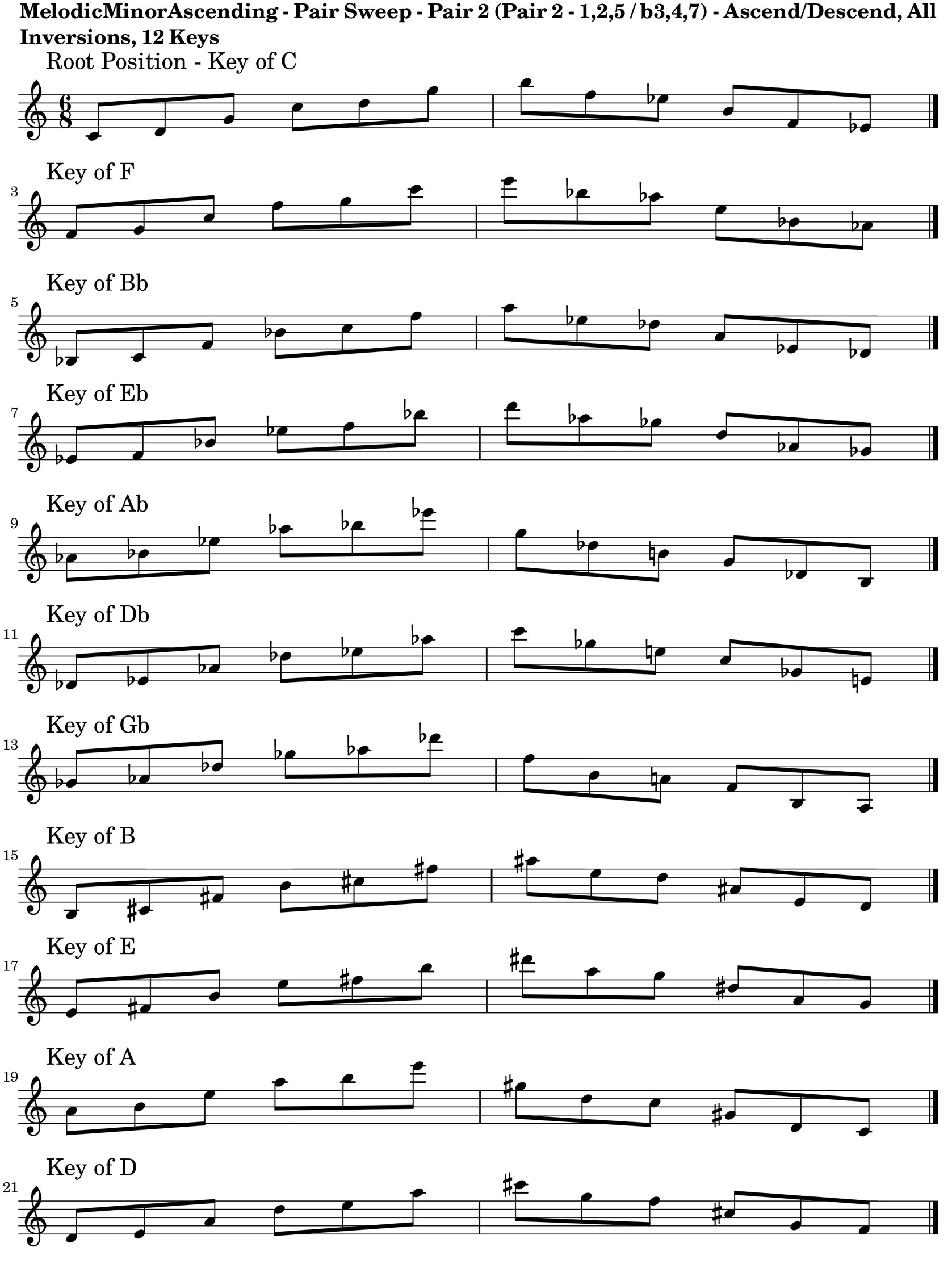
Sweep Pairs Melodic Minor Scale All Keys:
ISBN: 978-1-59489-296-7
for immediate download.
Trichord Pairs 2 — Harmonic Minor,
Harmonic Major, and the Symmetric Scales
Trichord Pairs covered major and melodic minor ascending —
the two scales where the 027-016 and 027-026 pairing system produces the richest set
of combinations, four to six per mode. Trichord Pairs 2 takes the same
method into different territory: harmonic minor, harmonic major, and the three symmetric
scales, where the underlying interval structure changes the math entirely.
Harmonic minor and harmonic major both contain an augmented second —
and that interval narrows the valid 027-026 pairing down to exactly one combination per
mode, rather than several. This book includes both of harmonic minor’s most commonly
used modes (the tonic harmonic minor sound, and the fifth mode’s Phrygian Dominant
— the classic altered-V7 sound), and all seven modes of harmonic major.
The symmetric scales — Whole-Half Diminished, Half-Whole Diminished,
and Whole Tone — work differently again. These scales repeat their own interval
pattern around the octave, so there’s no single 027 trichord anchoring every
combination the way there is in major or melodic minor. Instead, every combination in
this section pairs two 026 trichords against each other, and because the diminished
scales are eight notes rather than seven or six, there’s substantially more valid
combinations to work through — sixteen each for the two diminished scales, six
for whole tone, where every note of the scale is used with nothing left over.
Beyond the reference charts, this edition adds two new practice formats built for
taking a single trichord to the instrument. Sweeps takes each individual
trichord in the book through its three inversions, each swept up two octaves and back
down in a register built specifically to be playable on guitar. Pair Sweeps
links a combination’s two trichords into one continuous gesture — one trichord
sweeping up, the other sweeping back down — cycling through all three
inversions of both.
The complete mental practice, technique, and Long Line Rhythm system from
Trichord Pairs carries over unchanged — this book assumes you’re
either working through it alongside the original or have been through that material once
already.
What This System Gives You:
- Harmonic Minor, Fully Covered: The tonic Harmonic Minor
sound and the Phrygian Dominant (mode 5) — the two modes of harmonic minor
musicians reach for most. - Harmonic Major, All 7 Modes: One verified 027-026
combination per mode — the single valid pairing this scale’s own interval
structure allows. - All Three Symmetric Scales: 16 combinations from WholeHalf Diminished, 16 from Half-Whole Diminished, and 6 from Whole Tone — 38
combinations total from scales most trichord-pair material never touches. - Sweeps and Pair Sweeps: Every individual trichord in the
book taken through its three inversions in a guitar-practical register, plus every
combination linked into a continuous ascending-and-descending Pair Sweep. - The Same Complete Practice System: Mental practice,
Home Base technique, and Long Line Rhythm, applied directly to this new material. - Full PDF and MIDI Practice Files: Five kinds of files
— Overview, Sequence, Scale-Run, Sweep, and Pair Sweep — every
combination voiced eighteen ways and run through all twelve keys.
Table of Contents for Trichord Pairs 2:
- Front Matter: Acknowledgments, About the Author,
Foreword, Preface: How to Use This Book. - Chapter 1: Introduction — What’s In This Volume.
- Chapter 2: Mental Practice (full method, as in
Trichord Pairs) - Chapter 3: Technique and Physiology (full method,
as in Trichord Pairs) - Chapter 4: Long Line Rhythm (full method, as in
Trichord Pairs) - Chapter 5: The Trichord Pairs System
- Harmonic Minor — 027-026 Combinations (2 Modes).
- Harmonic Major — 027-026 Combinations (All 7 Modes).
- The Symmetric Scales — 026-026 Combinations.
- Whole-Half Diminished — 16 Combinations.
- Half-Whole Diminished — 16 Combinations.
- Whole Tone — 6 Combinations.
- Chapter 6: Sweeps — Individual trichords, three
inversions, two-octave sweeps in a guitar-practical register. - Chapter 7: Pair Sweeps — Linking a combination’s
two trichords into one continuous ascending-and-descending gesture. - Chapter 8: Practice Materials and Application
- Chapter 9: Troubleshooting, Context, and Consistency
- Conclusion
- Appendix A: The Muse Eek Ear Training Curriculum
- Appendix B: Pitch Class Sets, Chord Tones, and Available
Tensions — including a Trichord Usability Reference showing every chord
each trichord shape can be played over. - Harmonic and Melodic Equivalence Volume 11B is Included in this book a 19.99 value that gives indepth information on a Harmonic Major Scale Trichord
Examples of Exercises Found in Trichord Pairs 2
There are four types of exercise found in Trichord Pairs 2 Course. There are PDFs and MIDI files for all exercises. Below is a list of the exercise types:
1. Overview Exercises show you the all possible trichords for a given scale type.
2. Scale Run Exercises in all Harmonic Major, 2 modes of Harmonic Minor and 3 Symmetrical Scales.
3. Sweep Exercise in all Modes of Major, Melodic Minor Ascending, Harmonic Major, 2 modes of Harmonic Minor and 3 Symmetrical Scales Ascendig and Descending
4. Sweep Pairs Exercise shows you two trichords played ascending and descending.
This first example shows Overview Exercise for a Mixolydian b2b6 (5th Mode of Harmonic Minor) in All Keys
Overview Mixolydian b2b6 in All Keys:
This is the 2nd example shows Overview Exercise for a Symmetrical Diminished Scale (half step/whole step scale) in Key of C only.
Overview Example Symmetrical Diminished:
This example shows Scale Run Exercise using a Harmonic Major Scale in the Key of C only.
Scale Run Harmonic Major Scale:
This example shows Sweep Exercise using a Major Scale in All Keys
Sweep Pattern Major Scale All Keys:
This example shows Sweep Pairs Exercise using a Melodic Minor Scale in All Keys
Sweep Pairs Melodic Minor Scale All Keys:
ISBN: 978-1-59489-296-7
Trichord Sequencing (Major and Melodic Minor, with Six-Sweep and
Cascade Sweep)
Status: In stock. Digital book, PDF, and MIDI practice files available
for immediate download.
Trichord Sequencing — The Major Scale and
Melodic Minor, with Six-Sweep and Cascade Sweep
Trichord Sequencing takes the same major and melodic minor material as
Trichord Pairs — all seven modes of each — and adds two
brand-new sequencing formats built specifically around linking a pair’s two trichords
into a single continuous line.
The harmonic groundwork is identical to Trichord Pairs: major keeps its
full seven-mode, twenty-eight combination treatment, and melodic minor keeps its own
full seven-mode treatment too — forty-two combinations, the same complete
dataset as Trichord Pairs, not a narrower root-form-only version.
What’s new here is Six-Sweep and Cascade Sweep
— two ways of linking a combination’s two trichords into one unbroken line. Six-
Sweep draws on all three inversions of both trichords — six sweeps in total
— and links them into a single, continuous, ever-climbing line that alternates
ascending and descending until every inversion of both trichords has been played.
Cascade Sweep takes a different approach: it merges a pair’s two trichords into the six-
note scale their combined pitches form, then walks up that scale a step at a time,
adding the next note of whichever trichord that scale degree belongs to as a second
note at every step.
Seventy combinations in total, all provided across all twelve keys, in four practice
file formats — and the same complete mental practice, technique, and Long Line
Rhythm system as the rest of the series.
What This System Gives You:
- The Complete Major Scale System: All 28 valid 027-016
combinations across all seven modes — identical to Trichord Pairs. - The Complete Melodic Minor System: All 42 valid 027-026
combinations across all seven modes — identical to Trichord Pairs, not a
narrower root-form-only treatment. - Six-Sweep: Every combination’s two trichords swept through
all three inversions each, chained into one continuous, ever-climbing line —
found only in this volume. - Cascade Sweep: Every combination’s two trichords woven
together, one note at a time, into a single ascending-and-descending line —
found only in this volume. - The Same Complete Practice System: Mental practice,
Home Base technique, and Long Line Rhythm, unchanged from Trichord Pairs. - Full PDF and MIDI Practice Files: Four kinds of files
— Overview, Sequence, Six-Sweep, and Cascade Sweep — all
70 combinations, voiced across all 12 keys.
Table of Contents for Trichord Sequencing:
- Front Matter: Acknowledgments, About the Author,
Foreword, Preface: How to Use This Book. - Chapter 1: Introduction — What’s In This Volume.
- Chapter 2: Mental Practice (full method, as in
Trichord Pairs) - Chapter 3: Technique and Physiology (full method,
as in Trichord Pairs) - Chapter 4: Long Line Rhythm (full method, as in
Trichord Pairs) - Chapter 5: The Trichord Pairs System
- Major — 027-016 Combinations (All 7 Modes).
- Melodic Minor — 027-026 Combinations (All 7 Modes).
- Chapter 6: Six-Sweep — Linking all six inversions of
a pair’s two trichords into one continuous, ever-climbing line. - Chapter 7: Cascade Sweep — Weaving a pair’s two
trichords together two notes at a time up their combined six-note scale. - Chapter 8: Practice Materials and Application
- Chapter 9: Troubleshooting, Context, and Consistency
- Conclusion
- Appendix A: The Muse Eek Ear Training Curriculum
- Appendix B: Pitch Class Sets, Chord Tones, and Available
Tensions
Examples of Exercises Found in Trichord Sequencing
There are four types of exercise found in Trichord Pairs Sequencing Course. There are PDFs and MIDI files for all exercises. Below is a list of the exercise types:
1. Overview Exercises in all Modes of Major, Melodic Minor Ascending, Harmonic Major, 2 modes of Harmonic Minor and 3 Symmetrical Scales.
2. Sequencing Exercises for all Modes of Major and Melodic Minor Ascending.
3. Extended Trichord Sweep Patterns which shows all six patterns in all modes of Major and Melodic Minor Ascending.
4. Cascade Sweep Patterns in all modes of Major and Melodic Minor Ascending.
This first example shows Overview Exercise for a Dorian in Key of C Only

Overview Dorian Key of C Only:
Sequencing Exercise for a Major Scale in Key of C only.
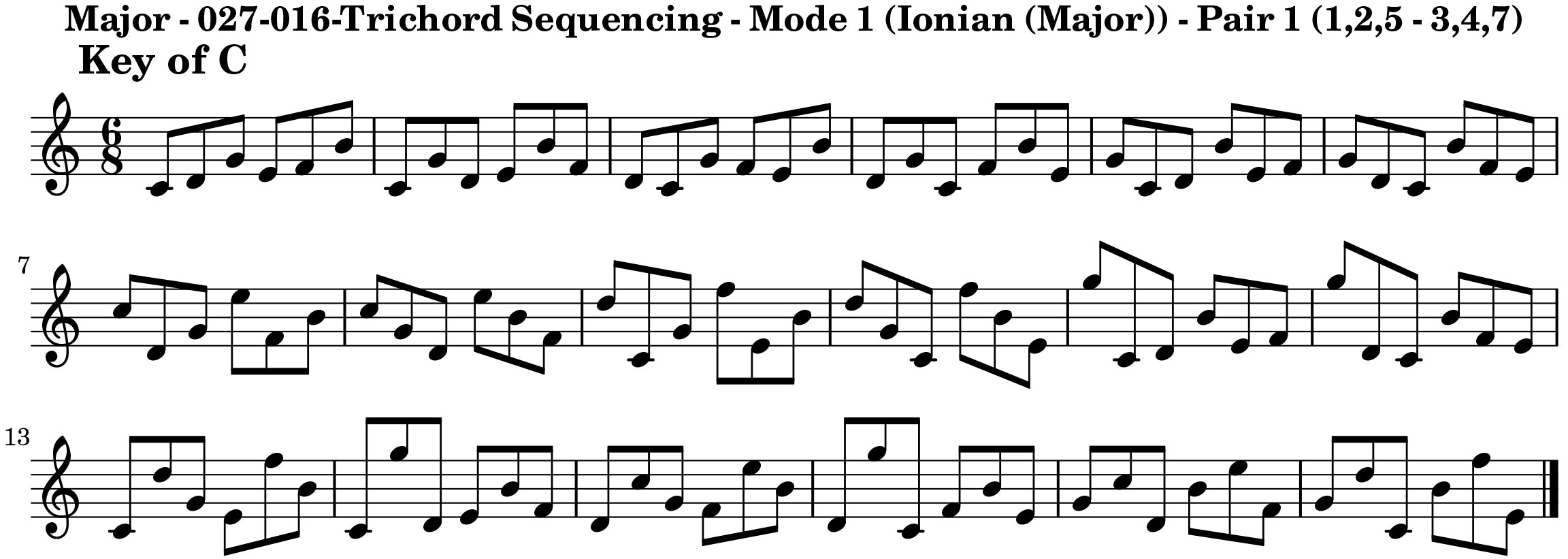
Sequencing Exercise for a Major Scale:
Sweep Exercise using a Melodic Minor Ascending Scale in Key of C Only

Sweep in Three Inversions:
This example shows Sweep Cascade Exercise using a C Dorian Scale Only

Sweep Cascade Key Of C Dorian:
ISBN: 978-1-59489-298-1
You don’t need good ear training skills for any book in this series, but a foundation in
contextual, key-center-based hearing is highly recommended — Appendix A in
every book lays out the ear-training curriculum this material depends on. For optimum
results, work through the combinations alongside a key-center-producing device like the
MetroDrone® app.
Chapter 3 in every book gives you enough physical technique to
work safely through this material, but it isn’t a complete guitar method — pair it
with Guitar Technique and Physiology for the full treatment, and see The Sonic Resource Guide for the deepest treatment of pitch class set theory.
Still Deciding? Get All Three Together
Frequently Asked Questions
There are a lot of technical exercises in this book. How do I make music out of them?
Trichord Pairs Series has a lot of technical exercises in it and my recommendation is to take each new technical idea and apply it to static chord progressions and then expand into whole chord progressions. I would also highly recommend writing song based on these technical patterns. That way you can see and hear them used in real music and get away from the technique side of things. Getting any new sound into your playing is a task. Be patient with this part of the work. It takes a long time for these ideas to become second nature to you but steady practicing and application to real music will get your there over time.
What’s the difference between the three books?
Trichord Pairs covers all seven modes of major and all
seven modes of melodic minor — the widest coverage of the two richest scales
for this system. Trichord Pairs 2 covers different territory entirely: harmonic
minor, harmonic major, and the three symmetric scales, plus two practice formats built
around a single trichord’s own inversions — Sweeps and Pair Sweeps, which draw
on trichords from across the whole series. Trichord Sequencing takes the
same major and melodic minor material as Trichord Pairs and works it into two
sequencing formats found nowhere else in the series, Six-Sweep and Cascade Sweep,
which link a pair’s two trichords into one continuous line rather than treating them as
separate practice units.
Do I need to buy them in order, or own Trichord Pairs before
the others?
No. Each book stands completely on its own and includes the full
mental practice, technique, and rhythm system in Chapters 2 through 4, so you don’t
need any of the other books to use any one of them. If you already own one and know
that method well, you can move through those chapters quickly in the others.
Is the bundle a one-time purchase or a subscription?
One-time purchase. The bundle unlocks all three digital books, along
with their full PDF and MIDI practice file sets, for immediate download — no
subscription or recurring charge.
What other books do you recommend using alongside this
series?
A few that pair naturally with the material in these books: Mental Practice for Musicians for a deeper treatment of the mental practice method used throughout, Guitar Technique and Physiology for the full hand-position and picking curriculum, The Sonic Resource Guide for the complete pitch class set theory behind each book’s Appendix B, and Ear Training One Note Complete and Contextual Ear Training to build the key-center hearing this whole system depends on.
What should I use to improvise over these combinations?
Get a looper if you can, and build loops using the two trichords as a
scale to solo over. If a looper isn’t an option, Jam Tracks Volume One, available on the Muse
Eek Publishing website, works well for this.
How much should I practice these trichord pairs each day?
As a starting point, spend about 30 minutes playing and memorizing a
single combination through one key. Then spend another 15 minutes improvising with
the scale, and with the chords if you play a chordal instrument. That’s a good baseline
— build up from there as it becomes comfortable.
Do I need to already know pitch class set theory to use these
books?
No. Appendix B in every book is a complete primer — prime
form, integer notation, and chord tones, tensions, and avoid notes worked out for every
common chord type — written for musicians with ordinary theory background and
no prior exposure to post-tonal thinking.
Any advice on how to make these examples actually sound
good?
Be very conscious of keeping the velocity even across each example
— very little change in loudness or attack from note to note. This isn’t easy to do
but will really help make them sound good. Chapter 7 in Trichord Pairs, and Chapter 9 in
Trichord Pairs 2 and Trichord Sequencing, cover this in more depth.
How do you recommend getting these sweeps and cascades into my
playing?
First I would highly recommend writing music that incorporates these
ideas and writing out solos to play over the music. Not that you want to verbatim play
the solos, but they will help you develop a style with these sounds and give you the
chops you need to execute these ideas in real time.
Could you point me to any examples of you using these sweeps
and cascades?
Yes, I would check out some of my latest recordings. The Cancelwood
Sessions is a good place to start, but I’ve been using these ideas for quite some time so
you will hear them every once and awhile in many recordings and live gigs. Check
youtube.com under my name for more examples.
Could you give me some idea on how to practice sweeps and
cascades?
I would start slow, because you can really hurt yourself if you do too
much too early in your development. If you are a guitarist, be very conscious of your
little finger on your fretting hand — that can get inflamed quite easily from the
stretches used in the sweeps and cascades.
Where is a good place to start with this book?
You can really start anywhere, but my recommendation is to work through each book in order that way you are slowly adding on more material and mastering parts of it as you go.”
A Proven Educational Lineage
The methods found on muse-eek.com are part of a historical musical
lineage stretching back to the 18th-century masters.
By using Muse-Eek books and courses, you are now a part of this
lineage—a tradition of excellence passing through legends like Charlie
Banacos and Jerry Bergonzi.
-
- Historically Validated
- University-Level Pedagogy
- Professionally Proven
Still not sure where to start? Feel free to contact us for a personalized recommendation based on your goals.