

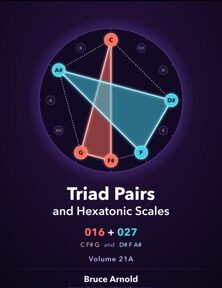

C F# G + D# F A# (1 b5 5 + b3 4 b7): a triad pair, made easy
A triad pair is just two three-note groups that you play back and forth. Here the two are C F# G and D# F A#. They aren’t built in thirds like a regular triad, which gives them a more open, modern sound. Put them together and you get a six-note (hexatonic) scale, C D# F F# G A#: a fresh, modern sound you can use in your solos right away.
This book gives you easy access to that sound. Everything is written out for you, in every key, with recordings to play along with. You don’t have to work anything out yourself: open the book, pick an exercise, press play.
What you get for $4.99
- 13 kinds of exercises (closed position, inversions, random inversions, rhythms and atomic scale exercises), each in all 12 keys, in treble clef and bass clef: 312 exercise sheets
- an MP3 to play along with and a MIDI file for every exercise
- 12 MetroDrone® drones, so you always hear the key center under you
- a 20-page guide: how to practice the pair, every way to order the six notes, and which chords and scales it works over
- for any instrument, and great for ear training and sight singing too
From me: I’ve spent my whole life playing, writing and teaching with triad pairs. You’ll hear them all over my records. These books put what I’ve learned into exercises you can start on today.
About the atomic scale exercises: this is the exercise I used to build my own ability with triad pairs. It’s the exercise my teacher Charlie Banacos recommended, and I’ve expanded it here into six versions, so you work through every order of the notes.
Hear me play it
Hear my music built on this kind of pair (016 + 027):
- 016 Blues
- A Few Dozen
See inside
Three pages from this volume (click to enlarge), and the MP3 that comes with the exercise:
 All the ways to order the six notes
 A solo guitar piece built on the pair
 An exercise: atomic scale exercise 4, key of D#
Hear it: the exercise shown above, as it sounds on the MP3 that comes with it.
Triad Pairs, Sound Cells or Hexachord Atlas: which one do I need?
All three are mine, and all three use the same idea: two three-note groups that make a six-note sound. The difference is what they do for you.
| Triad Pairs and Hexatonic Scales | Sound Cells | Hexachord Atlas | |
|---|---|---|---|
| What it is | The practice books | The deep study | The reference map |
| What you do with it | Play the pair every day until it’s in your hands and ears | Understand one pair completely: chords, scales, how to use it, and my compositions with it | Look up any six-note sound and see everything it can do |
| What’s inside | Hundreds of exercise sheets in all 12 keys, with MP3s and MIDI | A full book on the pair, with recordings of my music | Every hexachord, its trichord pairs, chords, rows and guitar shapes |
| Best for | Players who want to start using triad pairs now | Players who want to know the why | Composers and anyone who wants every possibility |
| Start here if | you’re new to triad pairs: $4.99 a book | you’ve practiced a pair and want to go deeper | you’re writing music |
Many players use them together: practice a pair here, then read about it in Sound Cells.
Want every pair? The complete Triad Pairs and Hexatonic Scales series has all 44 volumes for $44.99.
Triad Pairs and Hexatonic Scales Volume 21A: C F# G + D# F A# (1 b5 5 + b3 4 b7), 016 + 027
Triad Pairs and Hexatonic Scales Volume 21A: C F# G + D# F A# (1 b5 5 + b3 4 b7), 016 + 027
Status: In stock, Digital book is available for immediate access.
Triad Pairs and Hexatonic Scales Exercises
Part of the Triad Pairs and Hexatonic Scales Series
Triad Pairs and Hexatonic Scales Volume 21A: C F# G + D# F A# (1 b5 5 + b3 4 b7), 016 + 027 is part of a series of books on Pitch Class Set Improvisation called Triad Pairs and Hexatonic Scales. V21A Two Triad Pair is divided up into two sets of exercises written in treble and bass clef. The 1st set of exercises gets gradually harder but also more musical. Depending upon your musical skills you can start anywhere you want but for beginners I would recommend starting from the 1st exercise of the five.
The 2nd set of Pitch Class Set Improvisation exercises are called “Atomic Scales.” These exercises are a technical exercise that really helps you to learn these ideas but also sound great as a melody right off the bat. There are 6 different types of “Atomic Scales” exercises in this course. You don’t have to play every exercise in every key. But doing this will greatly increase the likelihood of you using it in real music in the future. Below is a listing of the exercises found in this course:
- Closed position studies.
- 1st inversion studies.
- 2nd inversion studies.
- Random combinations of closed position along with 1st and 2nd inversion.
- Random combinations of closed position along with 1st and 2nd inversion with rhythmic displacement.
- Atomic Scales Exercise 1
- Atomic Scales Exercise 2
- Atomic Scales Exercise 3
- Atomic Scales Exercise 4
- Atomic Scales Exercise 5
- Atomic Scales Exercise 6
Explanation of 2nd Set of Exercises in Triad Pairs and Hexatonic Scales Volume 21A: C F# G + D# F A# (1 b5 5 + b3 4 b7), 016 + 027 Course
Below is an explanation for each set of the 6 different atomic scale exercises found in this course. Three octave sequences that move back and forth between the two 3 note groups are presented in six different configurations.
These Pitch Class Set Improvisation exercises are highly melodic and can be used verbatim as melodies when soloing. If we thought of the three notes as A,B,C then there would be six different ways to combine these notes. i.e. ABC, ACB, BAC, BCA, CAB and CBA. All exercises include MP3s as well as midi files so that you can hear and play these exercises at any tempo as well as versions in all 12 keys.
- Three octave sequences that move back and forth between the two 3 note groups in the ABC sequence
- Three octave sequences that move back and forth between the two 3 note groups in the ACB sequence
- Three octave sequences that move back and forth between the two 3 note groups in the BAC sequence
- Three octave sequences that move back and forth between the two 3 note groups in the BCA sequence
- Three octave sequences that move back and forth between the two 3 note groups in the CAB sequence
- Three octave sequences that move back and forth between the two 3 note groups in the CBA sequence
1st Set of Exercises in Triad Pairs and Hexatonic Scales Volume 21A: C F# G + D# F A# (1 b5 5 + b3 4 b7), 016 + 027 Course
Here are a few examples from the 1st set of Pitch Class Set Improvisation exercises. A complete list of the different types of exercises can also be found below.
Closed Position Exercise

MP3 example
1st Inversion Exercise

MP3 example
2nd Inversion Exercise

MP3 example
Random combinations of closed position along with 1st and 2nd inversion.

MP3 example
Random combinations of closed position along with 1st and 2nd inversion and rhythm permutation

MP3 example
2nd Set of Exercises in Triad Pairs and Hexatonic Scales Volume 21A: C F# G + D# F A# (1 b5 5 + b3 4 b7), 016 + 027 Course
Here are a few Pitch Class Set Improvisation examples from the 2nd set of exercises.
Atomic Scales 1st Rotation

MP3 example
Atomic Scales 2nd Rotation

MP3 example
Atomic Scales 3rd Rotation

MP3 example
Atomic Scales 4th Rotation

MP3 example
Atomic Scales 5th Rotation

MP3 example
Atomic Scales 6th Rotation

MP3 example
TOC in the Triad Pairs and Hexatonic Scales Volume 21A: C F# G + D# F A# (1 b5 5 + b3 4 b7), 016 + 027 Course:
- How to Use This Course
- Harmonic/Melodic Possibilities of 016-027
- Chord Possibilities of 016-027
- Using 016-027 and its Complement in a Solo Blues Composition
- 016-027 Solo Blues Composition
- 016-027 Relationships in all Keys to Common Scales
- Thinking of the Trichords as One Scale
- C, F#, G and Eb, F, Bb Minus the Chromatic Pitch
Get Triad Pairs and Hexatonic Scales Volume 21A: C F# G + D# F A# (1 b5 5 + b3 4 b7), 016 + 027 Today!
Status: In stock, Digital book is available for immediate access.
Additional Information for Triad Pairs and Hexatonic Scales Volume 21A: C F# G + D# F A# (1 b5 5 + b3 4 b7), 016 + 027:
- Digital Edition 978-1-59489-335-3
- One 8 page PDF explaining exercises, 5 different types of exercises, 328 pages of exercises in PDF format in treble and bass clef
- MP3’s and Midi files for all exercises.
- 12 MP3s from Tuba MetroDrone®
What people are saying:
Hey Bruce, this is a very cool application of a Blues Scale. I really enjoy all the Pitch Class Set Improvisation information you have provided on alternate ways to use and think of the Blues scale. This is immediately useful information J. Ogland
I’m a Blues guy and this is really turning my head around. Such cool ideas in this book about how to split up a Blues scale but also how to use that split to form chord progressions. Thanks for all this mind bending stuff. W. Drews
Boy Bruce this course really knocks it out of the park. These “Atomic Scale” exercises using a Blues scale are awesome! I also appreciate your suggestion to start adding embellishments like bends and slides into the exercises. That really gives me to sound I’m striving for. J. Greig
Really a 21st century approach to an age old scale. Really digging the concept! T. Karen

Bruce Arnold playing Music Man Guitar in Concert