

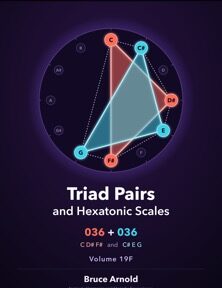

C diminished + C# diminished (1 b3 b5 + b2 3 5): a triad pair, made easy
A triad pair is just two three-note chords that you play back and forth. Here the two are C diminished (C D# F#) and C# diminished (C# E G), triads you probably already know. Put them together and you get a six-note (hexatonic) scale, C C# D# E F# G: a fresh, modern sound you can use in your solos right away. All six notes are in the C diminished (half-whole) scale, so you can use it anywhere that scale works.
This book gives you easy access to that sound. Everything is written out for you, in every key, with recordings to play along with. You don’t have to work anything out yourself: open the book, pick an exercise, press play.
What you get for $4.99
- 12 kinds of exercises (closed position, inversions, random inversions, rhythms and atomic scale exercises), each in all 12 keys, in treble clef and bass clef: 288 exercise sheets
- an MP3 to play along with and a MIDI file for every exercise
- 12 MetroDrone® drones, so you always hear the key center under you
- a 22-page guide: how to practice the pair, every way to order the six notes, and which chords and scales it works over
- for any instrument, and great for ear training and sight singing too
From me: I’ve spent my whole life playing, writing and teaching with triad pairs. You’ll hear them all over my records. These books put what I’ve learned into exercises you can start on today.
About the atomic scale exercises: this is the exercise I used to build my own ability with triad pairs. It’s the exercise my teacher Charlie Banacos recommended, and I’ve expanded it here into six versions, so you work through every order of the notes.
Hear me play it
These are spots in my own recordings where I play this same pair, in whatever key the tune was in. Press play and watch the notes light up: the two groups glow when the pair goes by.
See inside
Three pages from this volume (click to enlarge), and the MP3 that comes with the exercise:
 All the ways to order the six notes
 Which chords and scales the pair fits
 An exercise: atomic scale exercise 4, key of D#
Hear it: the exercise shown above, as it sounds on the MP3 that comes with it.
Triad Pairs, Sound Cells or Hexachord Atlas: which one do I need?
All three are mine, and all three use the same idea: two three-note groups that make a six-note sound. The difference is what they do for you.
| Triad Pairs and Hexatonic Scales | Sound Cells | Hexachord Atlas | |
|---|---|---|---|
| What it is | The practice books | The deep study | The reference map |
| What you do with it | Play the pair every day until it’s in your hands and ears | Understand one pair completely: chords, scales, how to use it, and my compositions with it | Look up any six-note sound and see everything it can do |
| What’s inside | Hundreds of exercise sheets in all 12 keys, with MP3s and MIDI | A full book on the pair, with recordings of my music | Every hexachord, its trichord pairs, chords, rows and guitar shapes |
| Best for | Players who want to start using triad pairs now | Players who want to know the why | Composers and anyone who wants every possibility |
| Start here if | you’re new to triad pairs: $4.99 a book | you’ve practiced a pair and want to go deeper | you’re writing music |
Many players use them together: practice a pair here, then read about it in Sound Cells.
Want every pair? The complete Triad Pairs and Hexatonic Scales series has all 44 volumes for $44.99.
Triad Pairs and Hexatonic Scales Volume 19F: C diminished + C# diminished (1 b3 b5 + b2 3 5), 036 + 036 by Bruce Arnold
Triad Pairs and Hexatonic Scales Volume 19F: C diminished + C# diminished (1 b3 b5 + b2 3 5), 036 + 036 is part of a series of books on Pitch Class Set Improvisation called Triad Pairs and Hexatonic Scales. V19F Trichord Pairsworks with a Two Triad Pair consisting of two diminished triads a half step apart. Using two triads gives your melodies a very modern sound. You can pivot back and forth between these triads in various ways and this course gives you 328 pages of exercises in all keys with MP3 and Midi files to do just that. Triad Pairs and Hexatonic Scales Volume 19F: C diminished + C# diminished (1 b3 b5 + b2 3 5), 036 + 036 also contains examples of how you could use these two triad pair in extended harmonic reharmonizations. These aspects make this the definitive study of this two triad pair.
Triad Pairs and Hexatonic Scales Volume 19F: C diminished + C# diminished (1 b3 b5 + b2 3 5), 036 + 036
Status: In stock, Digital book is available for immediate access.
Background Information on a Two Triad Pair or Two Trichords
“Triad Pairs and Hexatonic Scales” is a series of books that will help you to develop many different musical skills simultaneously. The source materials for these books are exercises that contain two 3 note groupings of notes which are also called a two triad pair or trichord pair. Any three note group of notes is often referred to as a “trichord.”
The Pitch Class Set Improvisation exercises contained in this course use many different types of harmonic and melodic ideas that can be superimposed over common chord progressions, scales and other musical situations. These exercises are also great for singing and rhythm studies so don’t overlook this aspect. The three note groupings in these “Triad Pairs and Hexatonic Scales” course can also be thought of as pitch class sets. For instance, in this volume C, Eb, Gb and Db, E, G are two 036 pitch class sets. The 036 is a diminished triad and contains a two minor thirds. The numbers indicate the number of half steps so C = 0, Eb = 3, Gb = 6. The 3 an 6 are indicated that they are 3 and 6 half steps above “C.” This is a great sequence because it forms part of a diminished scale but also can be used to outline dominant chords among other applications.
Unique Aspect of These Two Triad Pair Books
All of Mr. Arnold’s books have a sharp focus on the ear training aspect of any technique or idea. “Triad Pairs and Hexatonic Scales” Series is no different. Each example is always relating the idea of how you would hear this in real music. This book includes a section where the two triad pair are put into common chord progressions but more importantly are shown how these progressions relate to the overall key center. Learning music based on how your hear it rather than relating everything to a chord by chord approach is the rosetta stone of music. This is the secret to the previously undecipherable mystery of understanding music from an aural perspective.
Triad Pairs and Hexatonic Scales Series
This course is part of the Triad Pairs and Hexatonic Scales Series which explores over 50 different three note pairs that I’ve used in compositions and improvisations. To see all two triad pair volumes follow the link to explore each volume and hear examples from each course as well as finding links to compositions that I’ve written using each combination.
Triad Pairs and Hexatonic Scales Exercises
This course is divided up into two sets of Pitch Class Set Improvisation exercises written in treble and bass clef. The 1st set of exercises gets gradually harder but also more musical. Depending upon your musical skills you can start anywhere you want but for beginners I would recommend starting from the 1st exercise of the five. The 2nd set of exercises are called “Atomic Scales.” These exercises are a technical exercise that really helps you to learn these ideas but also sound great as a melody right off the bat. There are 6 different types of “Atomic Scales” exercises in this course. You don’t have to play every exercise in every key. But doing this will greatly increase the likelihood of you using it in real music in the future. Below is a listing of the exercises found in this course:
- Closed position studies.
- 1st inversion studies.
- 2nd inversion studies.
- Random combinations of closed position along with 1st and 2nd inversion.
- Random combinations of closed position along with 1st and 2nd inversion with rhythmic displacement.
- Atomic Scales Exercise 1
- Atomic Scales Exercise 2
- Atomic Scales Exercise 3
- Atomic Scales Exercise 4
- Atomic Scales Exercise 5
- Atomic Scales Exercise 6
Explanation of 2nd Set of Exercises in Triad Pairs and Hexatonic Scales Volume 19F: C diminished + C# diminished (1 b3 b5 + b2 3 5), 036 + 036 Course
Below is an explanation for each set of the 6 different atomic scale exercises found in this course. Three octave sequences that move back and forth between the two 3 note groups are presented in six different configurations. These exercises are highly melodic and can be used verbatim as melodies when soloing. If we thought of the three notes as A,B,C then there would be six different ways to combine these notes. i.e. ABC, ACB, BAC, BCA, CAB and CBA. All two triad pair exercises include MP3s as well as midi files so that you can hear and play these exercises at any tempo as well as versions in all 12 keys.
- Three octave sequences that move back and forth between the two 3 note groups in the ABC sequence
- Three octave sequences that move back and forth between the two 3 note groups in the ACB sequence
- Three octave sequences that move back and forth between the two 3 note groups in the BAC sequence
- Three octave sequences that move back and forth between the two 3 note groups in the BCA sequence
- Three octave sequences that move back and forth between the two 3 note groups in the CAB sequence
- Three octave sequences that move back and forth between the two 3 note groups in the CBA sequence
1st Set of Exercises in Triad Pairs and Hexatonic Scales Volume 19F: C diminished + C# diminished (1 b3 b5 + b2 3 5), 036 + 036 Course
Here are a few examples from the 1st set of exercises. A complete list of the different types of exercises can also be found below.
Closed Position Exercise

MP3 example
1st Inversion Exercise

MP3 example
2nd Inversion Exercise

MP3 example
Random combinations of closed position along with 1st and 2nd inversion.

MP3 example
Random combinations of closed position along with 1st and 2nd inversion and rhythm permutation

MP3 example
2nd Set of Exercises in Triad Pairs and Hexatonic Scales Volume 19F: C diminished + C# diminished (1 b3 b5 + b2 3 5), 036 + 036 Course
Here are a few examples from the 2nd set of exercises.
Atomic Scales 1st Rotation

MP3 example
Atomic Scales 2nd Rotation

MP3 example
Atomic Scales 3rd Rotation

MP3 example
Atomic Scales 4th Rotation

MP3 example
Atomic Scales 5th Rotation

MP3 example
Atomic Scales 6th Rotation

MP3 example
Atomic Scales 6th Rotation
MP3 example
TOC in the Triad Pairs and Hexatonic Scales Volume 19F: C diminished + C# diminished (1 b3 b5 + b2 3 5), 036 + 036 Course:
-
-
- How to Use This Course
- Harmonic/Melodic Possibilities of the two 036s.
- Chord Possibilities of the two 036s
- Two triad pair rotations Starting on Every Eighth Note
- How to think of the two 036s used in this course
- The two 036s Daily Exercise-Atomic Scales
- Thinking of the Trichords as Modes
- Thinking of the Trichords as One Scale
- C, Eb, Gb and Db, E, G as One Scale in All Keys
- Forming chord progressions with two triad pairs
- Forming extended chord progressions with two triad pairs
- Choosing chord progressions from two triad pairs
- Additional practice ideas
-
Get Triad Pairs and Hexatonic Scales Volume 19F: C diminished + C# diminished (1 b3 b5 + b2 3 5), 036 + 036 Today!
Status: In stock, Digital book is available for immediate access.
Additional Information for Triad Pairs and Hexatonic Scales Volume 19F: C diminished + C# diminished (1 b3 b5 + b2 3 5), 036 + 036:
-
-
- Digital Edition 978-1-59489-347-6
- One 13 page PDF explaining exercises, 5 different types of exercises, 328 pages of exercises in PDF format in treble and bass clef
- Information and examples of forming extended chord progressions with this two triad pair.
- MP3’s and Midi files for all exercises.
- 12 MP3s from Tuba MetroDrone®
-
What people are saying:
Hey Muse Eek, I’m very intrigued by each new volume in this series. Some like the Triad Pairs and Hexatonic Scales Volume 19F: C diminished + C# diminished (1 b3 b5 + b2 3 5), 036 + 036 seems to be lend itself to a more melodic scale like application and volumes like this volume can also be used as a way to outline common harmonic situations. I appreciate that through your emails, blogs and website information that you point these things out. It hasn’t always been obvious to me but I’m starting to see the bigger picture. Thanks! J. Ogland
Hey Bruce I just wanted to personally thank you for making all these books available for us at such a reasonable cost during the pandemic. I sure I’m not alone in my appreciation. I’ve been taking each new book and spending about 15 minutes a day exploring the combination presented. While that won’t make me an expert on the subject it has really expanded my understanding of the topic but also has given me some pretty cool licks that I can use straight away. Keep up the good work! H. Armstrong
Just wanted to drop you guys a note about your new Triad Pairs and Hexatonic Scales series. I’m finding the books in the 19 series to be the most readily adaptable to my current ability. I’ve been trying to find ways to help me learn the basic triads all over the guitar neck and these books have really helped me to see outside the box.
Before getting started with these books I just literally used a major triad or a major chord with the same process going for minor, diminished and augmented. These books have helped me see a whole other world that exists in the application of basic triads. The inclusion of ways to use two triad pairs as an extended chord progression really opened up a lot of new ideas for me. Thanks for all the hard work you are putting into this. E. Emerson
I’ve added these triad pairs into my daily routine. I found initially that they were very difficult but also made me realize how weak I was at physically playing triads. Now that I’ve been at it through multiple volumes I’m recognizing the triad shapes and that is really speeding up the process. With your recommendation I’ve been spending a little time applying each combination to jam tracks which has been hard but these combinations are beginning to be more second nature to me so they are making more sense when I improvise. W. Reagen
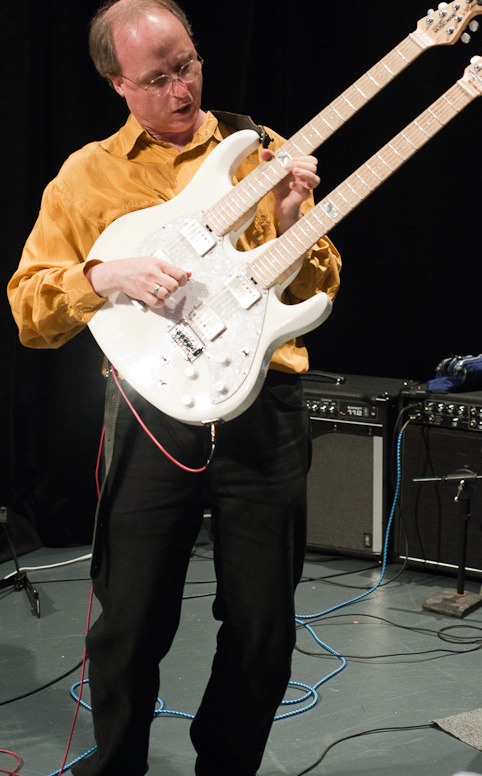
Bruce Arnold Author, Guitarist and Composer playing Music Man Guitar in NYC