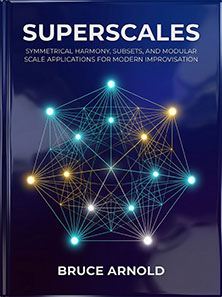
Symmetrical Harmony, Subsets, and Modular Scale Applications for Modern Improvisation
By Bruce Arnold — Muse Eek Publishing Inc. — ISBN 978-1-59489-178-6
A discovery with no precedent in the chord-scale literature.
Of all possible seven-note scales, exactly one has all twelve of its chromatic transpositions functioning over real chords in real chord progressions. That scale is Melodic Minor Ascending — and this book is the complete system built on that finding.
Every resource links directly from inside the book.
No download portal. No login. No hunting through folders. Click a link and get exactly what you need.
The full book in PDF, with access to all downloadable files: chord charts, subset PDFs, MIDI études, modal sequencing files, and trichord pair exercises — linked directly from inside the text. Everything you need to work through the complete MMA system in all twelve keys.
Most students who encounter Melodic Minor Ascending hit the same wall. They look at the seven diatonic chords of the scale and see three chord qualities that don’t show up in their everyday playing:
| MMA Mode | Chord Quality | Common reaction |
|---|---|---|
| Mode I — MMA itself | C-Δ7 (minor-major 7) | “I use this sometimes” |
| Mode II — Dorian ♭2 | D7sus4♭9 | “I almost never see this” |
| Mode III — Lydian ♯5 | E♭Δ7♯5 | “When would I use this?” |
| Mode IV — Lydian Dominant | F7♯11 | “Yes, this I know” |
| Mode V — Mixolydian ♭13 | G7♭13 | “Yes, this too” |
| Mode VI — Locrian ♮2 | A-7♭5add9 | “Half-diminished add 9? Skip.” |
| Mode VII — Altered | B7alt | “This I definitely need” |
The conclusion most students reach: “I only need Lydian Dominant, Mixolydian ♭13, and the Altered scale. I can skip the rest — and maybe skip MMA altogether.”
This is the single most common reason students abandon MMA before it has a chance to work. And it is based on a fundamental misreading of what the system is showing.
The misunderstanding: those “rare” chord qualities aren’t home chords. They’re keys to secondary dominants.
When you learn the MMA transposition rooted on E♭ — whose home chord is E♭Δ7♯5 — you are not learning a scale for E♭Δ7♯5 chords specifically. You are learning a transposition whose seven diatonic chords include a Lydian Dominant, an Altered dominant, a Mixolydian ♭13, and a half-diminished — all the sounds you already use, now available from one new key center.
Secondary dominants — dominant-function chords borrowed to tonicize scale degrees other than the tonic — appear in roughly 90% of Western tonal music. Jazz standards, blues, pop, country, classical harmony: the secondary dominant is everywhere. In any key, there are twelve dominant-function chords: the V7 of the key, plus the secondary dominant of every other scale degree.
Before knowing about the SuperScale property, the practical case for MMA was already strong: all seven MMA modes function over secondary dominants. That includes Dorian ♭2, Lydian ♯5, and Locrian ♮2 — the three modes students assume are too rare to bother with. Every one of those transpositions is the scale you need over a secondary dominant that appears constantly in real repertoire.
The SuperScale discovery takes this further: not just “all seven modes are useful” but “all twelve chromatic transpositions cover all twelve dominant-function chords in a single key center, verified computationally.” That is the deeper reason to learn every MMA transposition — including the ones whose home chord you think you’ll never encounter. You’re not learning it for the home chord. You’re learning it for the six other chords inside that transposition, several of which you use every time you play a standard.
| If you skip this transposition… | You lose access to these secondary dominants in C |
|---|---|
| E♭ MMA (home: E♭Δ7♯5) | A♭7♯11, B♭7♭13, C-7♭5, D7alt — all common in jazz standards |
| D MMA (home: D-Δ7) | G7♯11, A7♭13, B-7♭5, D♭7alt — V7 of G, V7 of A, and more |
| A♭ MMA (home: A♭-Δ7) | D♭7♯11, E♭7♭13, F-7♭5, G7alt — tritone subs and secondary dominants throughout |
This is why the book covers all twelve transpositions, and why the practice materials are organized to build fluency in each one from a single key center. Skipping the “unfamiliar” home chords means skipping the secondary dominant vocabulary that appears in almost every song you will ever play.
Music theory classifies scales by their internal interval structure — the pattern of whole steps and half steps that gives a scale its characteristic sound. This book is concerned with a different property entirely: not how a scale sounds in isolation, but how its twelve chromatic transpositions relate to the harmonic world around them.
A SuperScale is a pitch-class collection meeting two conditions simultaneously:
Both conditions must be met. The bar is high. That is precisely why the catalog of SuperScales is small — and why the seven-note result is so striking.
Of all possible seven-note scales, exactly one — Melodic Minor Ascending (set class 7-34, interval pattern W-H-W-W-W-W-H) — passes both SuperScale conditions for all twelve transpositions. Every other seven-note scale fails at least one condition for at least one transposition.
In the key of C, all twelve dominant-function chords — the tonic dominant plus all eleven secondary dominants — map precisely onto the twelve chromatic transpositions of MMA. The book includes the complete reference table for this mapping, with every chord, its corresponding MMA transposition, and its relationship to the key center. It is the core reference of the entire system, and it is immediately playable: every entry is a real chord from real repertoire paired with the MMA transposition that serves it.
There is a simple interval relationship that locates the correct transposition for any dominant chord, and it is explained in full in Chapter 2. But as the book makes clear, knowing the relationship and hearing the relationship are two different things — and only one of them works at performance tempo.
12 transpositions × 7 diatonic chords each = 84 distinct chord–scale relationships covered by one scale family, from one key center, without switching harmonic frameworks. That is before counting the subset scales within each transposition or the trichord pair applications.
The full seven-note MMA scale is the Rosetta Stone of the system. But the subsets drawn from it — the 4-, 5-, and 6-note collections that live inside MMA — are where many players will spend most of their time. Each size has a distinct musical character and a distinct set of applications. They are not simplified versions of the full system. They are different tools.
The six-note subsets of MMA are the sound of modern jazz harmony. Six notes leave six chromatic pitches unplayed — enough open space to avoid sounding scale-like, enough density to imply clear harmonic color. This is the sweet spot for sophisticated jazz improvisation: the hexatonics give you a contemporary, intervallic sound that sits comfortably over dominant and altered dominant chords without telegraphing every note of the underlying scale.
If you have worked through any of the Sound Cells series, you already know the hexatonic world. The MMA hexatonics are the subset of that world that maps directly onto the MMA key-center system — the same interval structures, now organized by transposition and confirmed computationally to function over real harmonic situations.
Pentatonics are universal. Every player knows the minor pentatonic. Most know the major pentatonic. The MMA system gives you 21 five-note subsets — all the pentatonic scales that live inside Melodic Minor Ascending, organized by key center and confirmed to function over real chords.
For rock and metal players especially, this is the most immediately actionable part of the book. You already think in pentatonics. The MMA pentatonic subsets hand you a systematic way to move beyond the minor and major boxes into sounds that are fresh without being foreign — still pentatonic in feel, but with interval structures you have not heard from your fingers before. Over a static dominant chord or a drone, these are immediately striking. They do not require a jazz context to work.
The full reference for all 38 pentatonic prime forms and their modes is documented in the Sonic Resource Guide (available separately). The MMA pentatonic subsets are the subset of that catalog confirmed to function within the MMA key-center system.
Four notes leave eight chromatic pitches unplayed. That open space is not emptiness — it is harmonic freedom. The four-note subsets have the highest average richness values in the entire SuperScale catalog, meaning they fit over the widest range of chords with the fewest conflicts. They are the most harmonically flexible material in the system.
In practice, four-note collections are the natural language of arpeggios and chord voicings. Every four-note subset in Chapter 5 is directly applicable as an arpeggio pattern — a complete melodic gesture that implies harmony without spelling it out note by note. For chord-melody players, composers, and anyone working with voicing-based improvisation, the four-note subsets give you a systematic library of arpeggio shapes drawn from the MMA system, each confirmed to function over real chord changes.
They are also the easiest entry point into the system. Fewer notes means less to track mentally, and the high richness means even a beginner with the MMA system will hear these land correctly over the MIDI drone files from the first practice session.
The complete SuperScale catalog by size — trichords through octatonics, with richness values and prime forms for every confirmed SuperScale — is documented in Appendix B of the book. The octatonic SuperScales are referenced there; the full octatonic practice framework is the subject of SuperScales III (forthcoming).
Every downloadable file is linked directly from inside the book — no login, no download portal, no hunting through folders. Purchase the book and every link below becomes available to you from the page it is discussed on.
| Category | What You Get | Chapter |
|---|---|---|
| MMA Chord Charts | All 12 MMA transpositions in all 12 keys, with diatonic chord labels and scale degree numbers. Standard notation and Roman numeral versions. 4 chart packages. | 4 |
| Subset PDFs | 4-, 5-, and 6-note subsets of MMA in standard notation and Roman numerals, plus subset comparison charts. 21 PDF files total. Includes pentatonics (rock and metal), hexatonics (modern jazz), and 4-note collections (arpeggios and chord voicings). | 5 |
| Trichord Pair Études | 2,521 étude files covering every MMA trichord pair combination in all 12 keys. | 6 |
| Progression Études & Accompaniment MIDIs | 864 accompaniment MIDI drone files and 2,521 étude files with rests — complete practice materials for all MMA transpositions over real chord progressions in all 12 keys. | 7 |
| Modal Sequencing Files | Modal sequencing files for 4-, 5-, and 6-note subsets and full MMA in all 12 keys. | 7 |
The most common mistake: practicing without a drone. Every exercise in this book is designed to be practiced against a drone. Without one, you are training your fingers without training your ear. The MIDI drones are included in every download package for exactly this reason.
Everything in this book depends on one ability: hearing pitches in relationship to a key center rather than as isolated notes or intervals. This is a trained skill, not a natural one. The recommended path is sequential — each level makes the next possible — but all three levels should be practiced concurrently once begun.
| Level | Resource | What It Builds |
|---|---|---|
| 1 | Ear Training One Note Complete | Hear a single pitch against a key center and identify which of the twelve chromatic degrees it is — not by counting intervals but by recognizing the specific sound of that degree. |
| 2 | Contextual Ear Training | Hear pitches in the context of real chord progressions — understanding not just what a note is, but how it functions given what is happening harmonically around it. |
| 3 — Critical | SerialEar | Hear all possible three-note structures (every trichord, every inversion, every transposition) against a drone in a key-center context. This is the step that makes the twelve MMA transpositions audible as twelve different colorings of one key center rather than twelve separate things to memorize. |
Not yet sure where to start? The free Ear Training Guided Tour explains the difference between interval-based and key-center hearing and maps the full curriculum.
| Book | How It Relates |
|---|---|
| Scale Analysis ISBN 978-1-59489-431-2 |
The practical companion to SuperScales. Applies the key-center approach to real chord progressions — twelve-bar blues, minor blues, and Rhythm Changes — across all 12 keys. Covers 28 prime forms including all seven MMA modes. If SuperScales is “why it works,” Scale Analysis is “how to hear it.” |
| My Music ISBN 1-890944-11-4 |
The theoretical and historical foundation for the MMA Trichord Pairs system in Chapter 6. Traces the compositional lineage from Stravinsky and Banacos through McCoy Tyner, and presents the harmonic rhythm principle — pivoting between two trichords in groups of 2, 3, or 4 eighth notes — that underlies the pivot exercises in the download package. |
| Sound Cells, Vols. 1–78 (forthcoming) | Covers all 78 possible trichord pair combinations, one per volume. Students who want to extend the trichord pair work in Chapter 6 beyond MMA — applying it to other hexatonic collections and harmonic contexts — will find the Sound Cells series the natural next step. |
| SuperScales II (forthcoming) | Takes the 84 diatonic chords across the 12 MMA transpositions as harmonic destinations in their own right. The compositional language of Wayne Shorter, Herbie Hancock, Bartók, and the broader post-functional harmony tradition — built on the aural foundation developed in this book. |
| SuperScales III (forthcoming) | Covers the eight-note SuperScale catalog in full — a complete practice framework parallel to the one in this volume, centered on the octatonic candidate C, D♭, E♭, E, G♭, G, A, B♭. |
The full book in PDF, with access to all downloadable files: chord charts, subset PDFs, MIDI études, modal sequencing files, and trichord pair exercises — linked directly from inside the text.
Do I need to know all 12 MMA transpositions before the system is useful?
No. The system is modular. Begin with the key of C, work through each transposition until the sound is in your ear, then move to one adjacent key. Even a partial command of the system — two or three keys — expands the harmonic vocabulary available from a single tonal center.
Is there a formula for finding the right MMA transposition over a dominant chord?
Yes, there are a few ways to formulate a reference to the correct MMA transposition, and they are shown in the book. But understand what this is: a crutch. At performance tempo, any calculation disappears. The goal is direct recognition — you know where you are in the key, you know the degree, and you hear the MMA sound that belongs there. The formula tells you where to go. Ear training is what makes you stop needing directions.
Can I use this system over non-dominant chords?
This volume concentrates on the twelve-transposition property specifically for dominant-function chords. There are also sections where each MMA transposition’s seven diatonic chords are covered — several of which are non-dominant qualities (minor-major 7, major 7 sharp 5, half-diminished add 9) — as part of each transposition’s harmonic universe. Overall the book concentrates on the use of the 12 dominant chords via the transpositions of the MMA scale. The subset exercises in Chapter 5 further extend the system’s reach into non-dominant territory.
Does the system require abandoning chord-by-chord scale thinking?
No — it offers an alternative, not a replacement. The chord-by-chord approach is powerful and widely used. The MMA system works best where music gives it room: on dominant chords held long enough to be heard, or on fast-moving changes where the ear stays in one key naturally. Learning to sense when the ear is staying and when it is moving is itself a musical skill that develops through the same practice as everything else in this book.
What instrument is this book written for?
The book is pitch-based and instrument-agnostic. The chord charts and subset exercises are written in treble clef in standard notation and apply equally to any pitched instrument. The MIDI practice files work with any DAW or MIDI playback setup. The trichord pair études are notated in standard treble clef notation. There are no bass clef notation examples in this book.
The principle of hearing music from a tonal center was not invented by Charlie Banacos. It was passed forward through three centuries of teaching. The core chain runs: Scarlatti → Porpora → Haydn → Beethoven → Czerny → Vengerova → Madame Chaloff → Banacos → Bruce Arnold.
Bruce Arnold studied with Banacos for five years. That training made the MMA discovery musically meaningful rather than merely mathematical. By working through the material in this book, you join that lineage.
Questions? Contact us below