/* ── Book cover image ── */ .book-cover { display: block; margin: 0 auto 20px; max-width: 222px; height: auto; border: 1px solid #ddd; }
/* ── Headings ── */ h2 { font-size: 1.4rem; margin: 24px 0 10px; color: #222; } h2.blue { color: #003594; border-bottom: 2px solid #003594; padding-bottom: 4px; } h3 { font-size: 1.1rem; margin: 18px 0 8px; color: #222; } h3.status { color: #2e7d32; font-size: 1.1rem; font-weight: bold; margin-bottom: 20px; } p { margin: 0 0 12px; text-align: justify; } ul, ol { margin: 0 0 14px 24px; } ul li, ol li { margin-bottom: 6px; }
/* ── Cart / CTA Button Block ── */ .cart_buttons { margin: 20px 0; background: #f9f9f9; padding: 15px; border-radius: 4px; border: 1px solid #eee; display: flex; align-items: center; gap: 15px; } .price-tag { font-size: 1.3rem; font-weight: bold; color: #222; } .button_go { display: inline-block; background-color: #f49e4e; color: #fff; padding: 12px 24px; text-decoration: none; border-radius: 3px; font-weight: bold; font-size: 1rem; white-space: nowrap; border: none; cursor: pointer; transition: background-color 0.2s ease; } .button_go:hover { background-color: #e08c38; }
/* ── Section Divider ── */ hr { border: none; border-top: 1px solid #ddd; margin: 28px 0; }
/* ── Prerequisites Box ── */ .prereq-box { border-left: 4px solid #003594; background: #f0f0f0; padding: 20px; margin: 25px 0; font-size: 0.95rem; }
/* ── Highlight Box (what's new / different) ── */ .highlight-box { border-left: 4px solid #f49e4e; background: #fff8f0; padding: 20px; margin: 25px 0; font-size: 0.95rem; }
/* ── Lineage Trust Box ── */ .lineage-box { max-width: 800px; margin: 40px auto 0; border: 1px solid #ddd; border-radius: 4px; overflow: hidden; background: #fff; box-shadow: 0 2px 4px rgba(0,0,0,0.05); } .lineage-header { background-color: #82C8E5; padding: 12px 20px; } .lineage-header h3 { margin: 0; color: #fff; font-size: 1.05rem; font-weight: bold; text-transform: uppercase; letter-spacing: 0.5px; } .lineage-body { padding: 20px; line-height: 1.6; } .lineage-body p { color: #333; margin-bottom: 10px; } .lineage-row { display: flex; flex-direction: row; justify-content: space-between; align-items: center; flex-wrap: wrap; gap: 20px; margin-top: 20px; } .lineage-list { margin: 0; padding-left: 20px; list-style-type: square; font-size: 0.9rem; color: #222; } .lineage-btn { display: inline-block; background-color: #f49e4e; color: #fff; padding: 12px 24px; text-decoration: none; border-radius: 3px; font-weight: bold; font-size: 0.9rem; white-space: nowrap; text-align: center; border: none; transition: background-color 0.2s ease; } .lineage-btn:hover { background-color: #e08c38; }
/* ── Combination count strip ── */ .stat-strip { display: flex; flex-wrap: wrap; gap: 14px; margin: 22px 0; } .stat-box { flex: 1 1 150px; background: #f0f4fa; border: 1px solid #dbe4f0; border-radius: 4px; padding: 14px 10px; text-align: center; } .stat-box .stat-num { display: block; font-size: 1.6rem; font-weight: bold; color: #003594; } .stat-box .stat-label { font-size: 0.82rem; color: #555; }
a { color: #003594; text-decoration: none; } a:hover { text-decoration: underline; } strong { font-weight: bold; } em { font-style: italic; }
/* ── Section divider ── */ hr { border: none; border-top: 1px solid #ddd; margin: 28px 0; } /* ── FAQ spacing ── */ .faq-q { font-weight: bold; margin: 20px 0 6px; font-size: 1.05rem; color: #003594; } .faq-a { margin-bottom: 14px; padding-left: 10px; border-left: 3px solid #eee; }
Most improvisers meet the blues scale the same way: as one fixed six-note shape, dropped over a dominant chord and left there. Blues Outside the Box starts from a different question — if a six-note scale is really just two three-note cells stacked together, how many genuinely different ways can the blues scale be split? The answer is a clean, closed number: ten. Not a curated subset — every single way to divide its six notes into two trichords, worked out in full and verified against real chord tones and tensions rather than assumed by habit.
Naming the harmony is the easy part. This book pairs that system with a complete mental practice method, physical technique, and macro-pulse rhythmic approach — the same complete-system philosophy behind the trichord-pair approach to major and melodic minor — so the material actually gets into your ear and your hands instead of sitting on the page.
Blues Outside the Box also tackles a question most blues-scale material never addresses directly: the scale’s built-in run of three consecutive half steps. This book shows you exactly when that run should be heard as a chromatic approach-note pattern — the same device bebop scales are built around — rather than three notes each needing to individually justify itself against the chord underneath.
Really the core of this course is superimposing the blues scale in various ways. One being the use of trichord pairs (triad pairs) to split the blues scale in half and the other is using the blues scale and superimposing it over other key centers.
You could think of the melodies found in this course more like SRV meets John Scofield or Mike Stern for tea. Also reminds me Robbin Fords playing. All these great players were pushing the limits and you can too with the melodies contained in this course.
There are four types of files found in the Blues Outside The Box
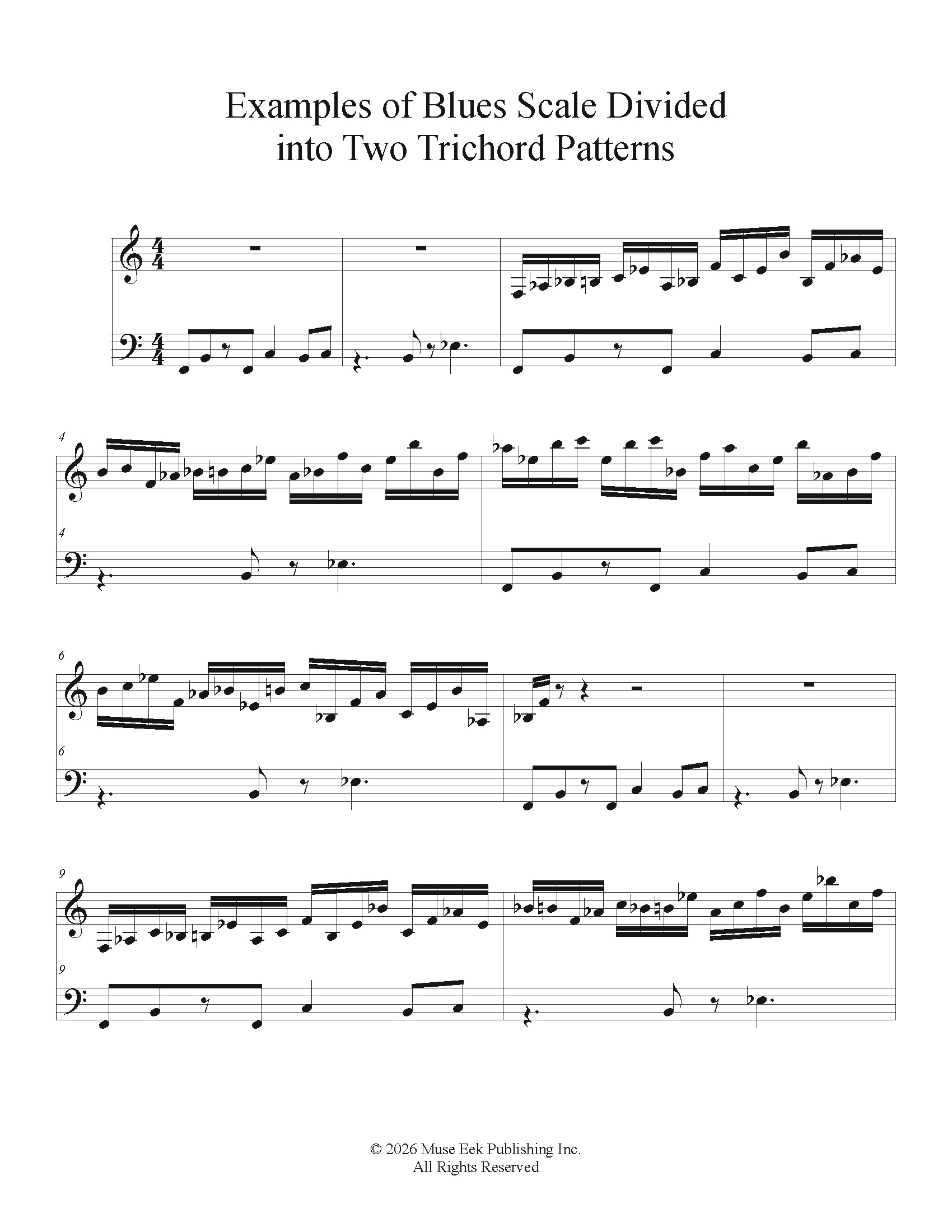
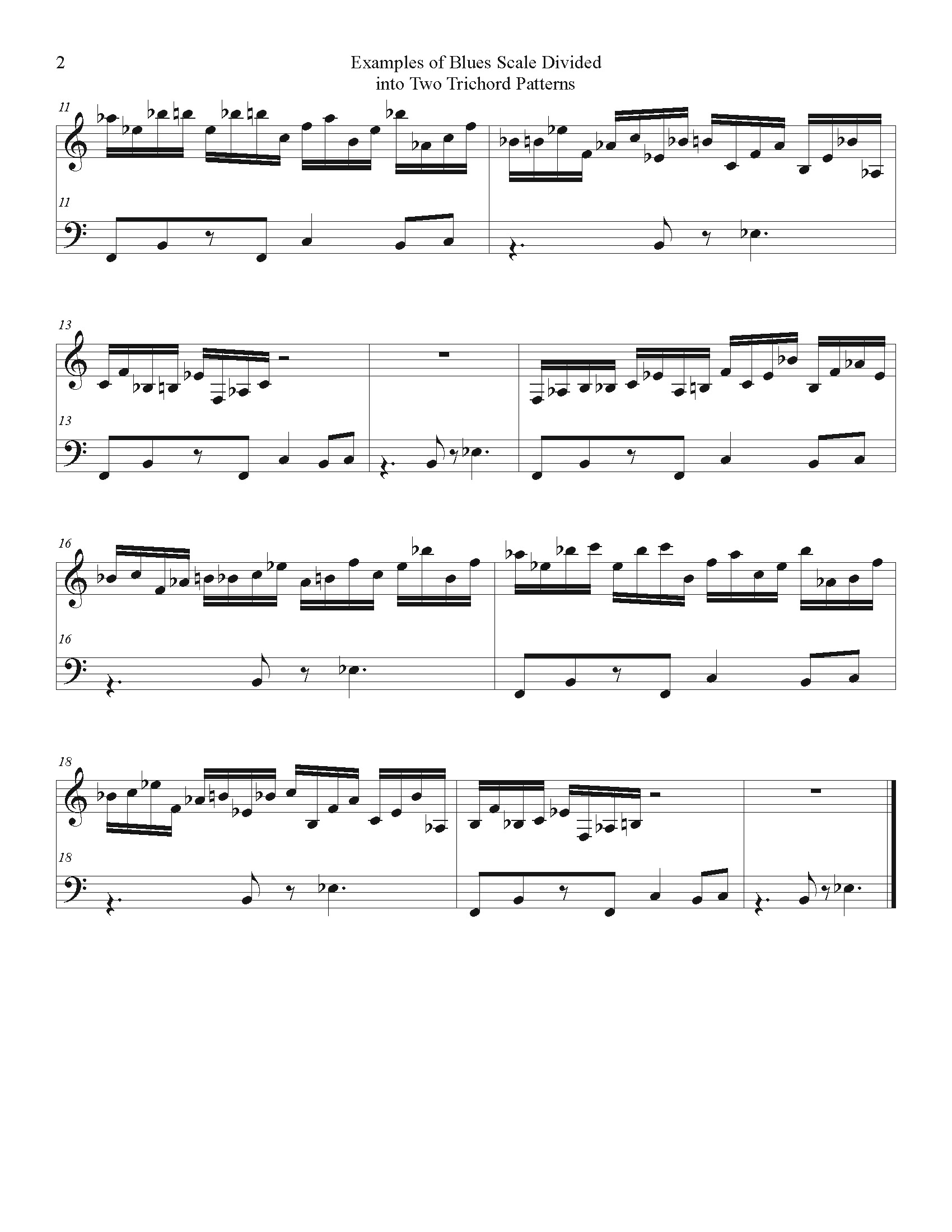
Rather than show you PDFs of the exercises I thought it might be of more value to hear what these exercises sound like in real music. This first example you can hear three of type of exercises presented found in this course. You will hear these lines played by guitar over a bass vamp. I highly recommend you permutate the rhythm within these examples when you add them to your vocabulary.
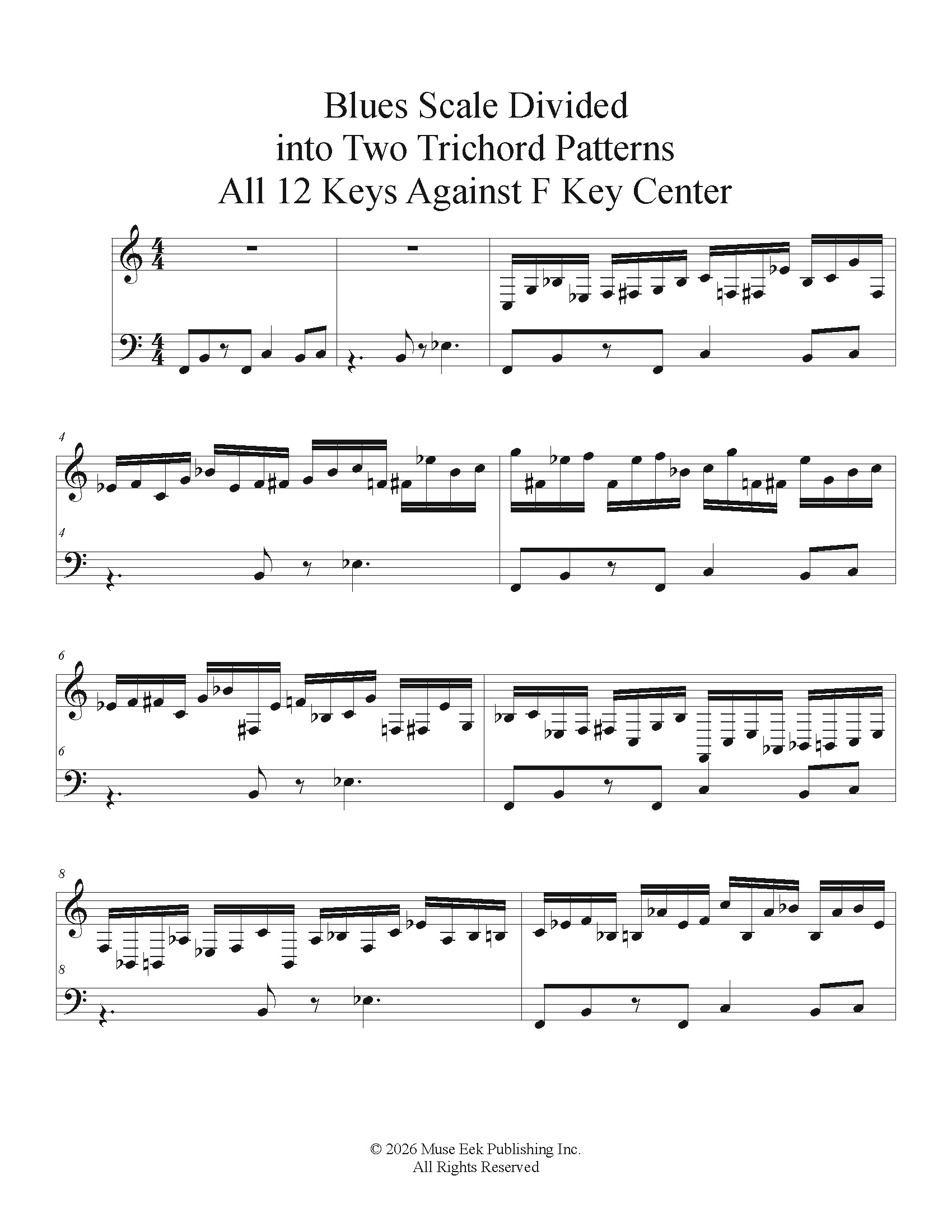
The 2nd example let’s you hear what all 12 blues scales sound like over an F bass vamp. I only give you the first page of the example because it’s quite long. I think you can hear from this example that blues scales in any key can work over a one key vamp. By using some of the additional techniques recommended in the book. i.e. Approach Notes in particular allows you to resolve the melodies in awesome ways.
ISBN: 978-1-59489-299-8
Do I need to already own Trichord Pairs to use this book?
No. Blues Outside the Box is a complete, standalone system built specifically around the blues scale. It uses the same mental practice, technique, and rhythm approach as Trichord Pairs, so if you already know that method, Chapters 2 through 4 will feel familiar — but nothing in this book assumes you own or have read the other title.
What other books do you recommend using alongside this one?
Guitar Technique and Physiology for the full hand-position and picking curriculum, The Sonic Resource Guide for the complete pitch class set theory behind Appendix B, and Ear Training One Note Complete and Contextual Ear Training to build the key-center hearing this whole system depends on.
What should I use to improvise over these combinations?
Get a looper if you can, and build loops using one of the ten trichord pairs as a scale to solo over. If a looper isn’t an option, Jam Tracks Volume One, available on the Muse Eek Publishing website, works well for this — the pairs in Chapter 5 sit especially naturally over static or slow-moving dominant vamps.
How much should I practice these trichord pairs each day?
As a starting point, spend about 30 minutes playing and memorizing a single pair through one key. Then spend another 15 minutes improvising with it — melodically, and with the chords if you play a chordal instrument. That’s a good baseline — build up from there as it becomes comfortable.
Do I need to know pitch class set theory to use this book?
No. Appendix B is a complete primer — prime form, integer notation, and a full chord-tone-and-tension breakdown for eight common chord types — written for musicians with ordinary theory background and no prior exposure to post-tonal thinking.
How is the superimposition analysis in Appendix B actually useful in practice?
It tells you, chord by chord, exactly which key’s blues scale sits entirely inside that chord’s tones and tensions (four such matches exist), and for every chord where no perfect match exists, exactly which single note is the outlier — almost always the b5 — so you know precisely what to treat as a passing tone rather than guessing.
Any advice on how to make these examples actually sound good?
Be very conscious of keeping the velocity even across each example — very little change in loudness or attack from note to note. This isn’t easy to do but will really help make them sound good. Chapter 7 covers this in more depth.
The methods found on muse-eek.com are part of a historical musical lineage stretching back to the 18th-century masters.
By using Muse-Eek books and courses, you are now a part of this lineage—a tradition of excellence passing through legends like Charlie Banacos and Jerry Bergonzi.
Still not sure where to start? Feel free to contact us for a personalized recommendation based on your goals.